Excavator operation JHA: hazards, controls and PPE.
Start from this template, add what's different on your site today, and have the crew sign.
| Hazards · Excavator operation |
|---|
| Struck by the swinging house or counterweight |
| Rollover on slopes and near trench edges |
| Quick coupler dropping the bucket |
| Utility and power line contact |
Controls
- Barricade or mark the swing radius. Spotter when people are near.
- Seat belt on. ROPS in place.
- Check the quick coupler pin every time you change attachments.
- Keep tracks back from trench edges, at least 2 ft and more in soft ground.
All 5 hazards and 7 controls → · 29 CFR 1926.602(a)
Toolbox talk: Swing radius and spotters
A starting point, not a finished JHA. Walk the site and have the competent person sign it.
Hazards
- Struck by the swinging house or counterweight
- Rollover on slopes and near trench edges
- Quick coupler dropping the bucket
- Utility and power line contact
- Falls getting on and off
Controls
- Barricade or mark the swing radius. Spotter when people are near.
- Seat belt on. ROPS in place.
- Check the quick coupler pin every time you change attachments.
- Keep tracks back from trench edges, at least 2 ft and more in soft ground.
- Lifting on a sling: use the lift chart and a rated lifting point.
- Three points of contact getting on and off.
- Bucket on the ground when parked.
PPE
- Hard hat
- High-vis vest (Class 2; Class 3 at night)
- Steel-toe boots
- Hearing protection
OSHA rules
29 CFR 1926.602(a) · 29 CFR 1926.600(a)(3) · 29 CFR 1926.651(j)(2) · 29 CFR 1926 Subpart CC
Toolbox talk: Swing radius and spotters
- The counterweight swings wider than you think. Stay out of the swing radius.
- Barricade it or mark it with cones and tape.
- Make eye contact with the operator before you walk near a machine.
- One spotter per machine, and they don't do other jobs while spotting.
- If you lose sight of the spotter, stop.
The full talk, with questions for the crew →
A starting point, not a finished JHA. Walk the site, add what's different today, and have the competent person sign it.
Tomorrow, the crew signs it on one phone.
Dozer writes the JHA and the toolbox talk from what you say and what the cameras saw yesterday. The crew signs on the foreman's phone, and it files itself in the site's day.
- One JHA per task, per day, in under a minute
- The toolbox talk that matches the work
- Signatures on one phone, no clipboard
- Filed with the daily log, ready for an inspector
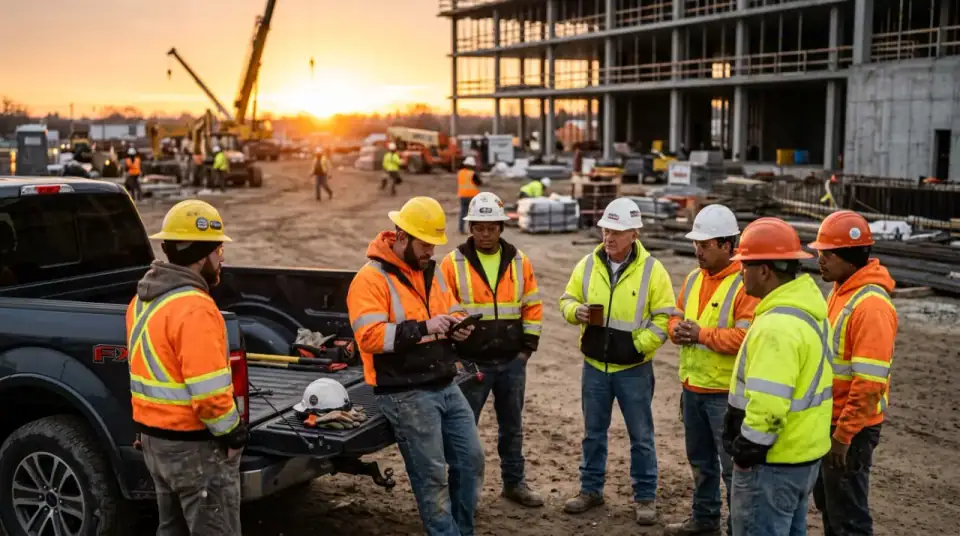 LIVE Toolbox talk · trench safety · 12 signed
Photo is an AI-generated stand-in, not a customer site.
Email me the PDF
We'll send this to you as a PDF, plus a reminder if there's a date in it. One email, no list.
We use it to send this and nothing else. See privacy.
Questions crews ask
What are the hazards of excavator operation?
Struck by the swinging house or counterweight. Rollover on slopes and near trench edges. Quick coupler dropping the bucket. Utility and power line contact. Falls getting on and off.
What controls go in a excavator operation JHA?
Barricade or mark the swing radius. Spotter when people are near. Seat belt on. ROPS in place. Check the quick coupler pin every time you change attachments. Keep tracks back from trench edges, at least 2 ft and more in soft ground. Lifting on a sling: use the lift chart and a rated lifting point.
What PPE is needed for excavator operation?
Hard hat, High-vis vest (Class 2; Class 3 at night), Steel-toe boots, Hearing protection. Add what your site and the task's SDS call for.
Which OSHA rules cover excavator operation?
29 CFR 1926.602(a); 29 CFR 1926.600(a)(3); 29 CFR 1926.651(j)(2); 29 CFR 1926 Subpart CC.
Your site at 6 a.m., before you're there.
Free for one site and one camera. $99 a site after. Crew is always free. 7 days of everything free, no card.