Pipe lifts JHA: hazards, controls and PPE.
Start from this template, add what's different on your site today, and have the crew sign.
| Hazards · Pipe lifts |
|---|
| Dropped load from a bad sling or hitch |
| Swinging pipe hitting a worker |
| Hands and feet crushed when setting pipe in the trench |
| Machine tipping when the lift is past its lift chart |
Controls
- Inspect slings before each shift; tag out and remove damaged ones.
- Tag lines on every pipe; nobody under the load.
- Rig to a rated lifting eye on the bucket or coupler, never a tooth.
- Check the lift chart for the weight and reach. An excavator lifting on a sling can fall under the crane rules.
All 4 hazards and 6 controls → · 29 CFR 1926.251
Toolbox talk: Rigging and tag lines
A starting point, not a finished JHA. Walk the site and have the competent person sign it.
Hazards
- Dropped load from a bad sling or hitch
- Swinging pipe hitting a worker
- Hands and feet crushed when setting pipe in the trench
- Machine tipping when the lift is past its lift chart
Controls
- Inspect slings before each shift; tag out and remove damaged ones.
- Tag lines on every pipe; nobody under the load.
- Rig to a rated lifting eye on the bucket or coupler, never a tooth.
- Check the lift chart for the weight and reach. An excavator lifting on a sling can fall under the crane rules.
- One person gives signals, and everyone knows who it is.
- Guide the pipe with a tag line or bar. Keep hands off the ends while it's lowered.
PPE
- Hard hat
- High-vis vest (Class 2; Class 3 at night)
- Steel-toe boots
- Work gloves
- Safety glasses
OSHA rules
29 CFR 1926.251 · 29 CFR 1926.651(e) · 29 CFR 1926 Subpart CC
Toolbox talk: Rigging and tag lines
- Inspect slings, shackles and hooks before each shift. Cut, kinked or crushed means out of service.
- Know the load weight and the sling's rated load for the hitch you're using.
- Pad sharp edges.
- Tag lines on every load. Never wrap a tag line around your hand.
- Nobody under the load.
The full talk, with questions for the crew →
A starting point, not a finished JHA. Walk the site, add what's different today, and have the competent person sign it.
Tomorrow, the crew signs it on one phone.
Dozer writes the JHA and the toolbox talk from what you say and what the cameras saw yesterday. The crew signs on the foreman's phone, and it files itself in the site's day.
- One JHA per task, per day, in under a minute
- The toolbox talk that matches the work
- Signatures on one phone, no clipboard
- Filed with the daily log, ready for an inspector
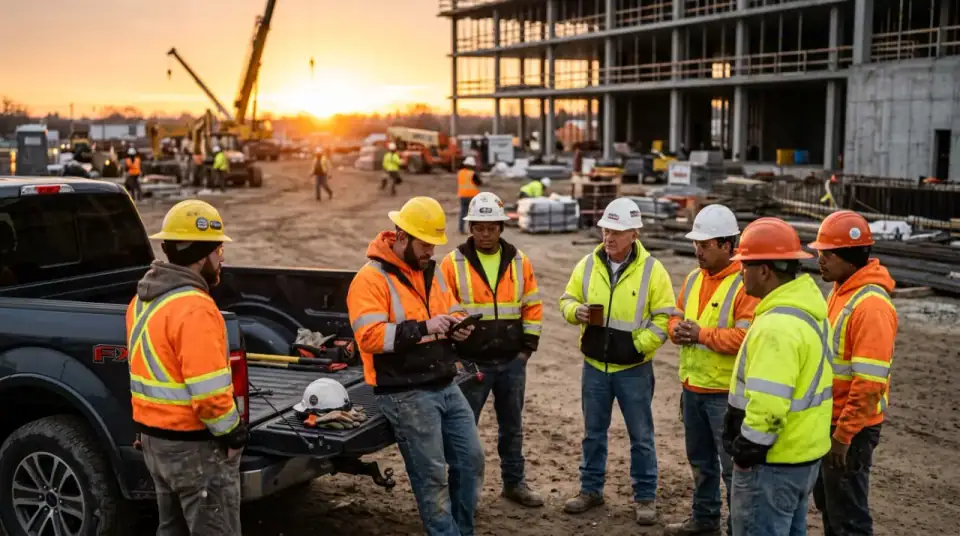 LIVE Toolbox talk · trench safety · 12 signed
Photo is an AI-generated stand-in, not a customer site.
Email me the PDF
We'll send this to you as a PDF, plus a reminder if there's a date in it. One email, no list.
We use it to send this and nothing else. See privacy.
Questions crews ask
What are the hazards of pipe lifts?
Dropped load from a bad sling or hitch. Swinging pipe hitting a worker. Hands and feet crushed when setting pipe in the trench. Machine tipping when the lift is past its lift chart.
What controls go in a pipe lifts JHA?
Inspect slings before each shift; tag out and remove damaged ones. Tag lines on every pipe; nobody under the load. Rig to a rated lifting eye on the bucket or coupler, never a tooth. Check the lift chart for the weight and reach. An excavator lifting on a sling can fall under the crane rules. One person gives signals, and everyone knows who it is.
What PPE is needed for pipe lifts?
Hard hat, High-vis vest (Class 2; Class 3 at night), Steel-toe boots, Work gloves, Safety glasses. Add what your site and the task's SDS call for.
Which OSHA rules cover pipe lifts?
29 CFR 1926.251; 29 CFR 1926.651(e); 29 CFR 1926 Subpart CC.
Related free tools
Your site at 6 a.m., before you're there.
Free for one site and one camera. $99 a site after. Crew is always free. 7 days of everything free, no card.