Work at height JHA: hazards, controls and PPE.
Start from this template, add what's different on your site today, and have the crew sign.
| Hazards · Work at height |
|---|
| Falls from edges, decks and floor openings |
| Falling through holes and skylights |
| Dropped tools and material hitting people below |
| Hitting the lower level because the lanyard is too long for the clearance |
Controls
- Guardrail or harness at 6 ft.
- Cover holes. Covers hold twice the load on them and are marked HOLE or COVER.
- Tie off to anchors good for 5,000 lb per person, or ones a qualified person designed.
- Check fall clearance. Free fall stays at 6 ft or less and nobody hits the level below.
All 4 hazards and 7 controls → · 29 CFR 1926.501(b)(1)
Toolbox talk: Ladders and harnesses
A starting point, not a finished JHA. Walk the site and have the competent person sign it.
Hazards
- Falls from edges, decks and floor openings
- Falling through holes and skylights
- Dropped tools and material hitting people below
- Hitting the lower level because the lanyard is too long for the clearance
Controls
- Guardrail or harness at 6 ft.
- Cover holes. Covers hold twice the load on them and are marked HOLE or COVER.
- Tie off to anchors good for 5,000 lb per person, or ones a qualified person designed.
- Check fall clearance. Free fall stays at 6 ft or less and nobody hits the level below.
- Toeboards, tool lanyards, and a barricaded zone below.
- Rescue plan in place before anyone ties off.
- Everyone exposed is trained on fall hazards.
PPE
- Full-body harness
- Shock-absorbing lanyard or self-retracting lifeline
- Hard hat with chin strap
- Non-slip boots
- Work gloves
OSHA rules
29 CFR 1926.501(b)(1) · 29 CFR 1926.502 · 29 CFR 1926.503
Toolbox talk: Ladders and harnesses
- Guardrail or harness at 6 ft.
- Extension ladders: 3 ft above the landing, 4 to 1 angle, tied off.
- Check the harness webbing, stitching and D-ring every day.
- Tie off to an anchor good for 5,000 lb, overhead when you can.
- Know how you'll get someone down if they fall.
The full talk, with questions for the crew →
A starting point, not a finished JHA. Walk the site, add what's different today, and have the competent person sign it.
Tomorrow, the crew signs it on one phone.
Dozer writes the JHA and the toolbox talk from what you say and what the cameras saw yesterday. The crew signs on the foreman's phone, and it files itself in the site's day.
- One JHA per task, per day, in under a minute
- The toolbox talk that matches the work
- Signatures on one phone, no clipboard
- Filed with the daily log, ready for an inspector
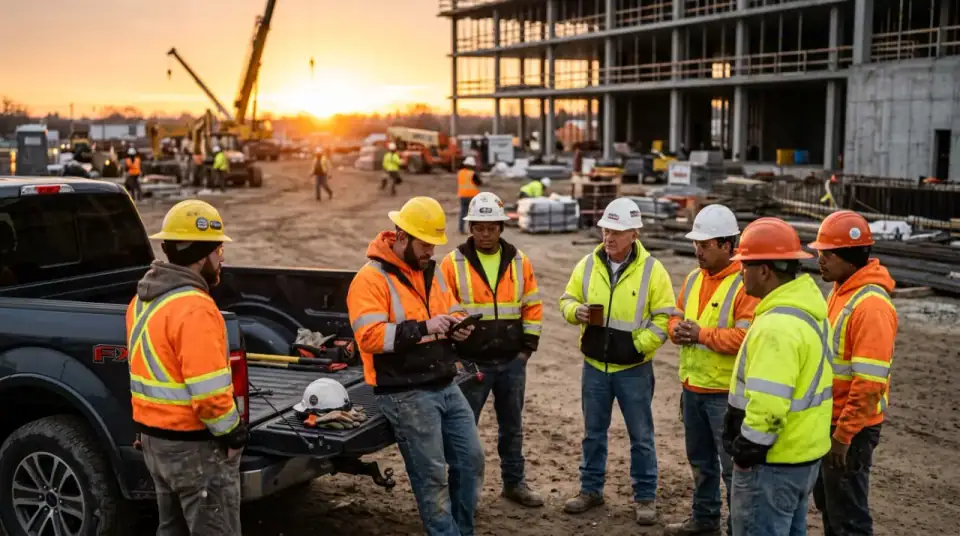 LIVE Toolbox talk · trench safety · 12 signed
Photo is an AI-generated stand-in, not a customer site.
Email me the PDF
We'll send this to you as a PDF, plus a reminder if there's a date in it. One email, no list.
We use it to send this and nothing else. See privacy.
Questions crews ask
What are the hazards of work at height?
Falls from edges, decks and floor openings. Falling through holes and skylights. Dropped tools and material hitting people below. Hitting the lower level because the lanyard is too long for the clearance.
What controls go in a work at height JHA?
Guardrail or harness at 6 ft. Cover holes. Covers hold twice the load on them and are marked HOLE or COVER. Tie off to anchors good for 5,000 lb per person, or ones a qualified person designed. Check fall clearance. Free fall stays at 6 ft or less and nobody hits the level below. Toeboards, tool lanyards, and a barricaded zone below.
What PPE is needed for work at height?
Full-body harness, Shock-absorbing lanyard or self-retracting lifeline, Hard hat with chin strap, Non-slip boots, Work gloves. Add what your site and the task's SDS call for.
Which OSHA rules cover work at height?
29 CFR 1926.501(b)(1); 29 CFR 1926.502; 29 CFR 1926.503.
Related free tools
Your site at 6 a.m., before you're there.
Free for one site and one camera. $99 a site after. Crew is always free. 7 days of everything free, no card.