Type the task. Get the JHA.
Hazards and controls in one table, plus the toolbox talk. Print it or get signatures.
| Hazards · Trenching |
|---|
| Utility strike: gas, power, water or fiber in the way |
| Cave-in: a trench wall gives way and buries someone |
| Struck-by: the bucket or the swinging excavator |
| Falling into the trench, or tools and spoils falling in |
Controls
- Call 811 and pothole before digging. Hand dig or vac near the marks.
- Trench box or slope at 5 ft or deeper. Over 20 ft deep, an engineer designs the protection.
- Competent person checks the trench daily, before each shift and after rain.
- Ladder, ramp or stairs within 25 ft of every worker in trenches 4 ft or deeper.
All 5 hazards and 8 controls → · 29 CFR 1926.651
Toolbox talk: Trench boxes
A starting point, not a finished JHA. Walk the site and have the competent person sign it.
JHA templates by task
Each template lists the hazards, the controls, the PPE and the OSHA rules for one kind of work, plus the toolbox talk that goes with it. Start from one, then add what's different on your site today.
- Trenching5 hazards
- Loading trucks4 hazards
- Pipe lifts4 hazards
- Paving5 hazards
- Work at height4 hazards
- Saw cutting6 hazards
- Near power lines4 hazards
- Excavation and earthwork5 hazards
- Utility locate (call 811)4 hazards
- Excavator operation5 hazards
- Skid steer and compact loader4 hazards
- Grading4 hazards
- Compaction5 hazards
- Rock drilling and blasting support5 hazards
- Asphalt milling5 hazards
- Pile driving5 hazards
- Dewatering and pumps5 hazards
- Underground pipe laying5 hazards
- Manhole and vault work5 hazards
- Fencing and post driving5 hazards
- Crane lift6 hazards
- Forklift and telehandler5 hazards
- Boom lift and scissor lift4 hazards
- Material handling and manual lifting5 hazards
- Concrete pour6 hazards
- Formwork5 hazards
- Rebar placement6 hazards
- Curb, gutter and sidewalk5 hazards
- Grinding and chipping concrete5 hazards
- Core drilling concrete5 hazards
- Tilt-up and precast panels4 hazards
- Steel erection4 hazards
- Masonry5 hazards
- Demolition6 hazards
- Roofing5 hazards
- Scaffolding5 hazards
- Ladder use4 hazards
- Work over or near water4 hazards
- Confined space entry5 hazards
- Hot work and welding6 hazards
- Temporary power and cords4 hazards
- Lockout/tagout on equipment4 hazards
- Fueling equipment4 hazards
- Painting and coatings5 hazards
- Spray foam insulation4 hazards
- Hand and power tools5 hazards
- Drywall5 hazards
- Glazing and window install5 hazards
- Plumbing rough-in5 hazards
- HVAC install5 hazards
- Chainsaw work5 hazards
- Tree removal and site clearing5 hazards
- Landscaping and mowing5 hazards
- Pressure washing5 hazards
- Traffic control4 hazards
- Flagging4 hazards
- Night work5 hazards
- Working in heat4 hazards
- Working in cold4 hazards
How to write a job hazard analysis
- Pick the task. One JHA per kind of work: trenching, setting pipe, paving. Not one for the whole job.
- Break it into steps. What the crew does, in order. Five to eight steps is plenty.
- List the hazards for each step. What could hurt someone: struck-by, caught-between, falls, cave-in, electrical, heat.
- Write the control for each hazard. Get rid of it first, then guard it, then train, then PPE.
- Name the competent person. Trenching, scaffolds and fall protection need one by name.
- Walk it with the crew and sign. A JHA nobody read is paperwork. Five minutes at the tailgate makes it real.
Tomorrow, the crew signs it on one phone.
Dozer writes the JHA and the toolbox talk from what you say and what the cameras saw yesterday. The crew signs on the foreman's phone, and it files itself in the site's day.
- One JHA per task, per day, in under a minute
- The toolbox talk that matches the work
- Signatures on one phone, no clipboard
- Filed with the daily log, ready for an inspector
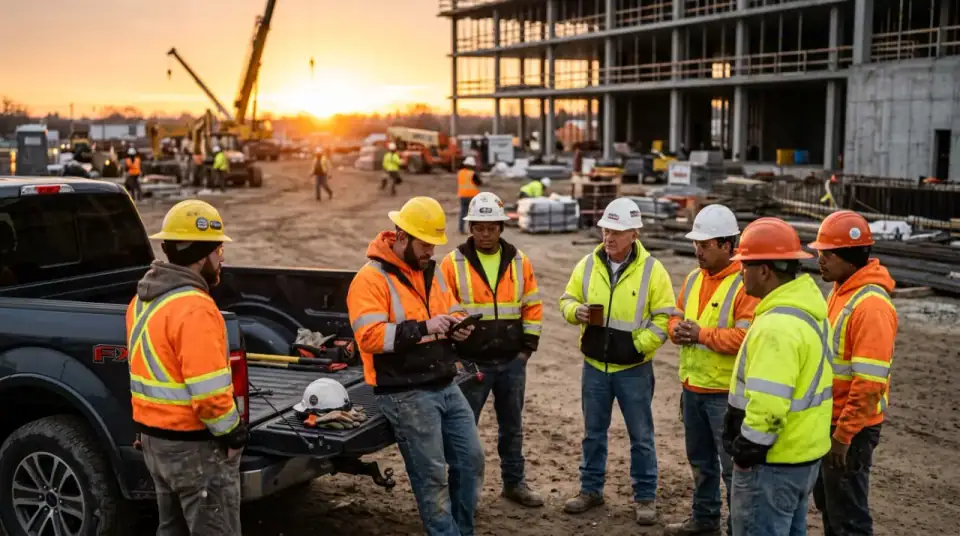 LIVE Toolbox talk · trench safety · 12 signed
Photo is an AI-generated stand-in, not a customer site.
Email me the PDF
We'll send this to you as a PDF, plus a reminder if there's a date in it. One email, no list.
We use it to send this and nothing else. See privacy.
Questions crews ask
What's the difference between a JHA and a JSA?
Nothing that matters on site. A job hazard analysis (JHA) and a job safety analysis (JSA) both break a task into steps, list the hazards of each step and the control for each hazard. Some companies say AHA (activity hazard analysis), which is what USACE's EM 385-1-1 calls it.
Does OSHA require a JHA?
Federal OSHA doesn't require a written JHA for most construction work, but it's the easiest way to show you planned for the hazards its rules cover. Many GCs require one daily, and USACE jobs require an AHA for every phase of work under EM 385-1-1.
What goes in a job hazard analysis?
The task and its steps, the hazards for each step, the control for each hazard, the PPE, who's the competent person, and signatures from the crew. OSHA's guide is publication 3071.
Is the JHA builder free?
Yes. The template part runs right in the page. The AI part, which writes it from a sentence, needs the Dozer API and is also free to use here.
Related free tools
Your site at 6 a.m., before you're there.
Free for one site and one camera. $99 a site after. Crew is always free. 7 days of everything free, no card.