Near power lines JHA: hazards, controls and PPE.
Start from this template, add what's different on your site today, and have the crew sign.
| Hazards · Near power lines |
|---|
| Electrocution when a boom, bucket, dump bed or load touches a line |
| Arcing: at high voltage you don't have to touch the line |
| Ground current around a machine that hits a line |
| Downed lines after a strike or a storm |
Controls
- Keep 10 ft from lines up to 50 kV. More for higher voltage: 15 ft to 200 kV, 20 ft to 350 kV.
- Don't know the voltage? Keep 20 ft away (50 ft over 350 kV) until the utility tells you.
- Treat every line as live until the utility says it's de-energized and grounded.
- Dedicated spotter for any machine that could get inside the distance.
All 4 hazards and 6 controls → · 29 CFR 1926.1408 Table A
Toolbox talk: Overhead lines
A starting point, not a finished JHA. Walk the site and have the competent person sign it.
Hazards
- Electrocution when a boom, bucket, dump bed or load touches a line
- Arcing: at high voltage you don't have to touch the line
- Ground current around a machine that hits a line
- Downed lines after a strike or a storm
Controls
- Keep 10 ft from lines up to 50 kV. More for higher voltage: 15 ft to 200 kV, 20 ft to 350 kV.
- Don't know the voltage? Keep 20 ft away (50 ft over 350 kV) until the utility tells you.
- Treat every line as live until the utility says it's de-energized and grounded.
- Dedicated spotter for any machine that could get inside the distance.
- Look up before raising a dump bed, boom or mast. Mark lines with flags or range limits.
- If a machine hits a line: stay in the cab. If you must get out, jump clear with feet together and shuffle away. Keep everyone back.
PPE
- Hard hat (Class E)
- High-vis vest (Class 2; Class 3 at night)
- EH-rated boots
- Work gloves
OSHA rules
29 CFR 1926.1408 Table A · 29 CFR 1926.600(a)(6) · 29 CFR 1926.416(a)(1)
Toolbox talk: Overhead lines
- Look up before you raise a boom, bed or mast.
- Keep 10 ft from lines up to 50 kV. More for higher voltage.
- Don't know the voltage? Keep 20 ft and call the utility.
- Use a dedicated spotter when you could get close.
- If you hit a line, stay in the cab. Keep everyone away.
The full talk, with questions for the crew →
A starting point, not a finished JHA. Walk the site, add what's different today, and have the competent person sign it.
Tomorrow, the crew signs it on one phone.
Dozer writes the JHA and the toolbox talk from what you say and what the cameras saw yesterday. The crew signs on the foreman's phone, and it files itself in the site's day.
- One JHA per task, per day, in under a minute
- The toolbox talk that matches the work
- Signatures on one phone, no clipboard
- Filed with the daily log, ready for an inspector
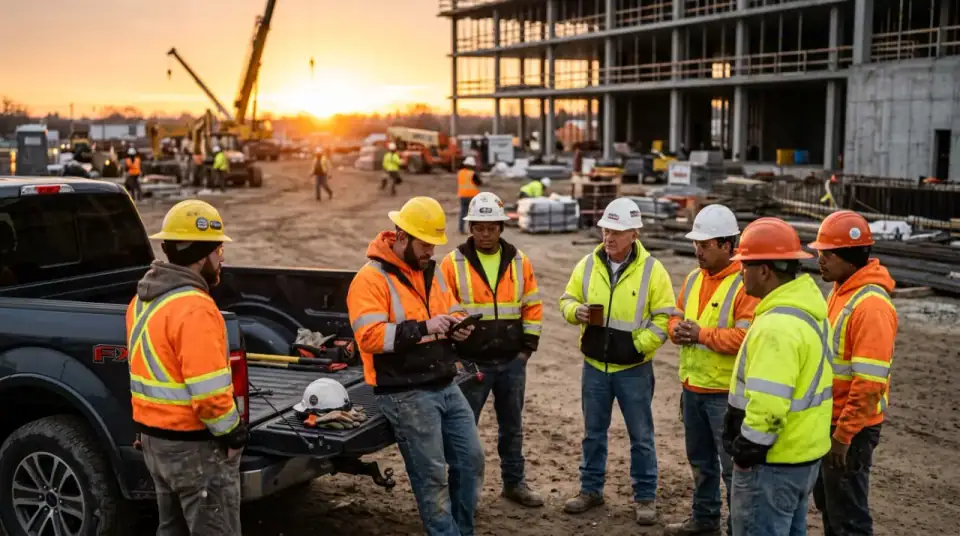 LIVE Toolbox talk · trench safety · 12 signed
Photo is an AI-generated stand-in, not a customer site.
Email me the PDF
We'll send this to you as a PDF, plus a reminder if there's a date in it. One email, no list.
We use it to send this and nothing else. See privacy.
Questions crews ask
What are the hazards of near power lines?
Electrocution when a boom, bucket, dump bed or load touches a line. Arcing: at high voltage you don't have to touch the line. Ground current around a machine that hits a line. Downed lines after a strike or a storm.
What controls go in a near power lines JHA?
Keep 10 ft from lines up to 50 kV. More for higher voltage: 15 ft to 200 kV, 20 ft to 350 kV. Don't know the voltage? Keep 20 ft away (50 ft over 350 kV) until the utility tells you. Treat every line as live until the utility says it's de-energized and grounded. Dedicated spotter for any machine that could get inside the distance. Look up before raising a dump bed, boom or mast. Mark lines with flags or range limits.
What PPE is needed for near power lines?
Hard hat (Class E), High-vis vest (Class 2; Class 3 at night), EH-rated boots, Work gloves. Add what your site and the task's SDS call for.
Which OSHA rules cover near power lines?
29 CFR 1926.1408 Table A; 29 CFR 1926.600(a)(6); 29 CFR 1926.416(a)(1).
Related free tools
Your site at 6 a.m., before you're there.
Free for one site and one camera. $99 a site after. Crew is always free. 7 days of everything free, no card.