
How often does OSHA require scaffold inspections?
Before each work shift, and after anything that could weaken it. A competent person does it.
WorkFrame scaffold, 3 lifts, east wall, masons on it all week
| Hazards |
|---|
| Falls from the platform |
| Scaffold collapse or tip-over |
| Falling tools and material |
| Power line contact |
Controls
- Competent person inspects before each shift.
- Guardrail or harness over 10 ft. Top rail 38 to 45 in.
- Fully planked. Base plates and mudsills on firm ground.
- Ladder or stair access; never climb the cross braces.
Toolbox talk: Scaffold check before you climb
- 1Sign upWith email, Google or Apple.
- 2Tell it about the siteLike you'd tell a new foreman.
- 3It opens, built for your siteJHA & talks, plus crew sign-off on one phone
OSHA requires a competent person to inspect a scaffold and its components for visible defects before each work shift, and again after any occurrence that could affect its structural integrity (29 CFR 1926.451(f)(3)). That's the whole schedule: every shift the scaffold is used, plus after a hit, a storm or a change. OSHA's rule doesn't ask for the inspection to be written down or for a tag on the scaffold.
Checked 2026-11-21 against the eCFR text of 29 CFR 1926 Subpart L, current to November 19, 2026, and OSHA's letters of interpretation.
Every check in OSHA's scaffold rules
On November 20, 2026 we read every paragraph of Subpart L, 1926.450 to 1926.454 with its appendices. Seven paragraphs ask someone to inspect or test something on site. Two more set lab or design tests: hoists tested by a qualified testing laboratory (1926.451(d)(13)) and electrical tests for insulated aerial lifts (1926.453(b)(3)). None of the nine asks for a written record of the check, and the word "tag" appears once, in "tag lines" for swinging loads (1926.451(f)(9)).
| What gets checked | Who | When | Rule |
|---|---|---|---|
| The scaffold and its components, for visible defects | Competent person | Before each work shift, and after anything that could affect its structural integrity | 29 CFR 1926.451(f)(3) |
| Suspension scaffold ropes | Competent person | Before each workshift, and after anything that could affect the rope | 29 CFR 1926.451(d)(10) |
| Wire rope clips on suspension scaffolds (inspect and retighten) | Not named | At the start of each workshift | 29 CFR 1926.451(d)(12)(iv) |
| Manila or synthetic rope used as a toprail or midrail | Competent person | As often as needed to keep it at the required strength | 29 CFR 1926.451(g)(4)(xiv) |
| Overhead members an interior hung scaffold hangs from | Not named | Before the scaffold is erected | 29 CFR 1926.452(t)(2) |
| Boom lift controls (test) | Not named | Each day before use | 29 CFR 1926.453(b)(2)(i) |
| Boom lift before road travel: boom cradled, outriggers stowed | Not named | Before moving it for travel | 29 CFR 1926.453(b)(2)(xii) |
"Not named" means the paragraph says the check happens but not who does it. The general rule still applies: frequent and regular inspections of the site, materials and equipment by competent persons the employer names (1926.20(b)(2)).
Outside Subpart L, OSHA's construction rules name the same competent person for trenches (1926.651(k)) and cranes (1926.1412(d)), each before the shift too. A site with a scaffold and a trench open runs both checks every morning. The trench safety rules cover the other one.
What the competent person looks at
The rule says "visible defects" and leaves the list to the inspector. The rest of 1926.451 is the list. These are the lines a shift inspection checks the scaffold against:
| Check | What the rule says | Rule |
|---|---|---|
| Load | Each scaffold and component holds its own weight and at least 4 times the maximum intended load. Don't load past the rated capacity. | 29 CFR 1926.451(a)(1), (f)(1) |
| Planking | Each working platform fully planked or decked, with gaps no more than 1 in between units and next to the uprights, unless a wider gap is shown to be needed. | 29 CFR 1926.451(b)(1)(i) |
| Footing | Legs, posts and frames on base plates and mud sills or another firm foundation. Footings level, sound and rigid. No unstable objects holding it up. | 29 CFR 1926.451(c)(2) |
| Ties | A supported scaffold taller than 4 times its base width is guyed, tied or braced against tipping. | 29 CFR 1926.451(c)(1) |
| Access | A ladder, stair tower, ramp or similar when the platform is more than 2 ft above or below the point of access. Cross braces aren't access. | 29 CFR 1926.451(e)(1) |
| Fall protection | Anyone more than 10 ft above a lower level is protected. Toprails on supported scaffolds placed in service after January 1, 2000 sit 38 to 45 in above the platform. | 29 CFR 1926.451(g)(1), (g)(4)(ii) |
| Power lines | At least 3 ft from insulated lines under 300 volts, and 10 ft from 300 volts to 50 kV. | 29 CFR 1926.451(f)(6) |
| Weather and debris | Nobody works on a platform covered in snow, ice or other slippery material except to clear it. No work in storms or high winds unless a competent person says it's safe and the crew is tied off or behind wind screens. No debris piling up. | 29 CFR 1926.451(f)(8), (f)(12), (f)(13) |
A part that fails isn't fixed later. Anything damaged or weakened below the strength the rule requires is repaired or replaced right away, braced to meet the rule, or taken out of service until it's repaired (1926.451(f)(4)). And nobody changes a scaffold on their own: erecting, moving, taking down or altering one happens only under a competent person's supervision, by trained workers that person picked (1926.451(f)(7)).
After an occurrence
The second trigger is any occurrence that could affect the scaffold's structural integrity. The rule doesn't list them. On a job site that's usually one of these: a machine, truck or swinging load hits it; high wind or a storm; another trade pulls a tie, a brace or a plank; the ground under a base plate settles, washes out or freezes and thaws; or a load bigger than planned goes on the platform. Inspect again before anyone climbs back up, even halfway through a shift. Suspension scaffold ropes have their own version: after any occurrence that could affect the rope (1926.451(d)(10)).
Who can inspect a scaffold
A competent person, which OSHA defines as "one who is capable of identifying existing and predictable hazards in the surroundings or working conditions which are unsanitary, hazardous, or dangerous to employees, and who has authorization to take prompt corrective measures to eliminate them" (1926.32(f)). Two things, then: they can see the problem, and they can stop the work or fix it.
The rule doesn't set a course or a card for it. OSHA's May 21, 1999 letter says the standard doesn't specify training for the competent person, but that the preamble expects specific training in, and knowledge of, the scaffold's structural integrity. As a practical matter, the letter says, the competent person needs the same training as a scaffold erector. Anyone involved in inspecting a scaffold has to be trained by a competent person in its hazards and in the right way to inspect that type of scaffold (1926.454(b)).
What OSHA's letters add
- Only the parts in use. On a big system, the inspection is required for the areas employees will use during the next shift. The company that built the scaffold doesn't have to be the one that inspects it every day (letter of August 5, 1997).
- Material on the deck. Materials stored on a platform can hide part of its top surface from the inspector. OSHA's letter of October 30, 2003 says that in most cases it's enough to look at the bottom surface, and treats storing more than one shift's material as a de minimis violation as long as the rest of the scaffold rules are met.
- Letters explain, they don't add. A letter of interpretation explains how a rule applies; it can't create a new duty. The 1997 letter is in OSHA's archive, marked as possibly no longer current policy.
Do you need a written record or a tag?
Not under federal OSHA. Subpart L requires the inspection and says nothing about writing it down or tagging the scaffold. Write it down anyway. When an inspector asks whether the scaffold was checked this morning, a dated line with a name answers it; memory doesn't. OSHA's own scaffold guide (OSHA 3150) carries the Construction Focused Inspection Guidelines, which look for a project plan with "documentation of: training, permits, hazard reports, inspections, uncorrected hazards, incidents, and near misses."
A useful line has six things: the date and time, which scaffold (its location on the site), who inspected it, what they found, what was fixed or tagged out, and whether it's cleared for use. Green, yellow and red tags are a common way to show that at the ladder, and your GC or owner may require them. They're a site rule, not an OSHA one.
Why it gets cited
Scaffolding, construction (29 CFR 1926.451) is number 4 on OSHA's preliminary list of the most frequently cited standards for fiscal year 2026 (October 1, 2025 to August 31, 2026), behind fall protection, hazard communication and lockout/tagout. Fall protection training in construction (1926.503) is number 8. The shift inspection is the cheapest line in that standard to get right.
Where Dozer fits
Dozer's scaffolding JHA lists the hazards and controls for the crew to sign, and the scaffold check talk puts the shift inspection in front of them in five points. The morning inspection goes on the day's daily report as a line: what was checked, by whom, and what was fixed. Dozer doesn't inspect the scaffold. The competent person does.
Sources
Checked on 2026-11-21. eCFR text current to November 19, 2026.
- 29 CFR 1926.451, scaffolds: general requirements (eCFR)
- 29 CFR 1926.452, additional requirements for each scaffold type (eCFR)
- 29 CFR 1926.453, aerial lifts (eCFR)
- 29 CFR 1926.454, scaffold training (eCFR)
- 29 CFR 1926 Subpart L, the whole subpart with appendices (eCFR)
- 29 CFR 1926.32(f), competent person defined (eCFR)
- 29 CFR 1926.20(b), inspections by competent persons (eCFR)
- OSHA letter, August 5, 1997: daily inspection of scaffolds
- OSHA letter, May 21, 1999: training for the competent person inspecting scaffolds
- OSHA letter, October 30, 2003: materials stored on a scaffold for more than one shift
- OSHA's index of letters on 1926.451(f)(3)
- OSHA 3150, A Guide to Scaffold Use in the Construction Industry (PDF)
- OSHA's top 10 most frequently cited standards
A summary of the federal rule, not legal or safety advice. State plans (California, Washington, Oregon and others) can add to it, and the competent person on site has the final word.
Tomorrow, the crew signs it on one phone.
Dozer writes the JHA and the toolbox talk from what you say about the work.
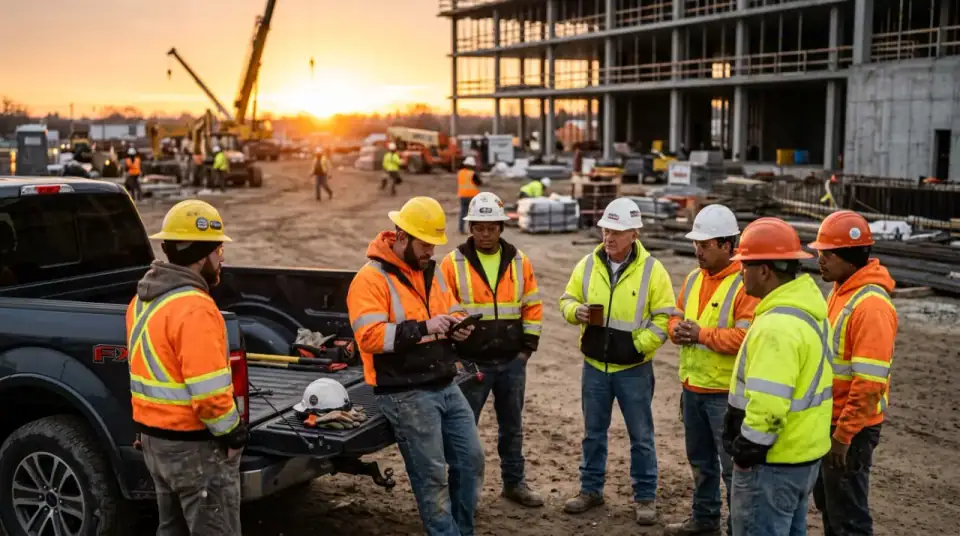 LIVE Toolbox talk · trench safety · 12 signed
AI-generated stand-in photo, not a customer site.
Questions
Something else? Ask a person.
How often does OSHA require scaffold inspections?
Before each work shift, and after any occurrence that could affect the scaffold's structural integrity. A competent person does it and looks for visible defects (29 CFR 1926.451(f)(3)).
Who can inspect a scaffold?
A competent person: someone who can spot existing and predictable hazards and has the authority to fix them right away (29 CFR 1926.32(f)). OSHA's May 21, 1999 letter says this person needs to know the scaffold's structural integrity, in practice the same training as a scaffold erector.
Does OSHA require a written scaffold inspection record?
No. Subpart L asks for the inspection, not a record of it. A written record is still how you show it happened, and many GCs and owners require one.
Does OSHA require scaffold tags?
No. Subpart L doesn't mention inspection tags; the only "tag" in it is tag lines for swinging loads (1926.451(f)(9)). Green, yellow and red tags are a site or company practice. Follow them where your GC uses them.
Does the whole scaffold have to be inspected every shift?
Only the parts the crew will use that shift. OSHA's August 5, 1997 letter says the inspection is required for the scaffold areas employees will use during the next work shift, and that the company that built it doesn't have to be the one inspecting it.
What counts as an occurrence that needs another inspection?
The rule says any occurrence that could affect the scaffold's structural integrity. On a site that's things like a machine or a load hitting it, high wind, a tie or plank taken out by another trade, or ground that's settled or washed out under a base plate.
Put an AI foreman on your site.
Tell it about your site. It sets up the rest.