Confined space entry permit, signed on one phone.
Test the air in order, name the attendant and the rescue, then the crew signs before anyone goes in.
WorkPull wire in electrical vault V-3, 9 ft deep
Air at 7:10O₂ 20.9% · LEL 0% · H₂S 0 · CO 3 ppm
Crew2 entrants, 1 attendant
- Rig the tripod and winch: a vertical entry over 5 ft needs retrieval.
- Air is good. Keep the 4-gas meter running inside.
- The attendant stays out, even if someone goes down.
- 1Sign upWith email, Google or Apple.
- 2Tell it about the siteLike you'd tell a new foreman.
- 3It opens, built for your siteJHA & talks, plus crew sign-off on one phone
What the permit covers
OSHA's construction rule for confined spaces is 29 CFR 1926 Subpart AA, in force since August 2015. The permit is the plan for one entry, written down and signed before anyone goes in.
- The space, the work and the time the permit runs.
- Entrants, the attendant and the entry supervisor, by name.
- Hazards and how each one is controlled: lockout, blanking lines, ventilation.
- Air test results, initial and ongoing, with who tested and when.
- Rescue: who comes, how to call them, and the retrieval gear on hand.
- How entrants and the attendant stay in touch.
- Other permits that go with it, like hot work.
Acceptable air
Test before entry and keep testing. A blower helps, but it doesn't replace the meter.
| Test, in this order | OK to enter |
|---|---|
| Oxygen | 19.5% to 23.5% |
| Flammable gas | Under 10% of the LEL |
| Toxic gas (H₂S, CO) | Under the exposure limit |
In Dozer
Dozer starts the confined space JHA from the work you describe, with the hazards, the controls and the gear. The crew reads it and signs on one phone, and it stays with the site's daily log for the GC.
A starting point, not legal or safety advice. Check it against the regulation cited and your own site.
Tomorrow, the crew signs it on one phone.
Dozer writes the JHA and the toolbox talk from what you say about the work.
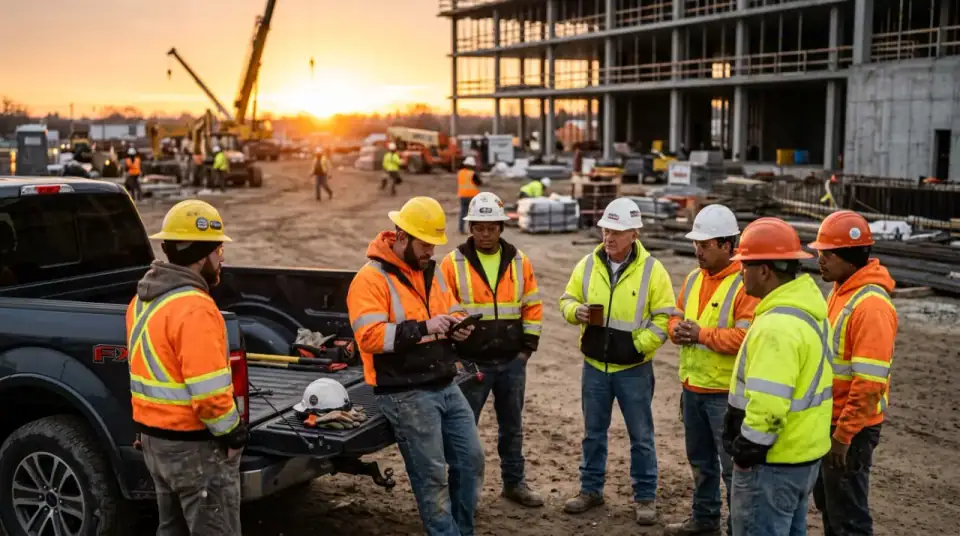 LIVE Toolbox talk · trench safety · 12 signed
AI-generated stand-in photo, not a customer site.
Questions
Something else? Ask a person.
What is a permit-required confined space?
A space big enough to get into, with limited ways in or out, not built for people to stay in, that also has a serious hazard: bad air, something that can bury you, a shape that can trap you, or any other serious hazard. Manholes, vaults, tanks, pits and crawl spaces are the usual ones (29 CFR 1926.1202).
What goes on a confined space entry permit?
The space, the work, the date and how long the permit lasts, the entrants and attendants by name, the entry supervisor's signature, the hazards and how they're controlled, the air test results with who tested and when, the rescue service and how to call it, how entrants and the attendant talk, the equipment, and any other permits like hot work (1926.1206(b)).
What order do you test the air in?
Oxygen first, then flammable gases, then toxic gases. Oxygen has to be between 19.5% and 23.5%, flammables under 10% of the lower explosive limit, and toxics under their exposure limits. Keep testing while people are inside.
Can the attendant go in to rescue someone?
No. The attendant stays outside the whole time, calls rescue and uses the retrieval line. Most confined space deaths are would-be rescuers. For a vertical entry deeper than 5 ft, a retrieval system with a mechanical device must be ready.
How long is a confined space permit good for?
No longer than the job needs. The supervisor cancels it when the work is done or when something outside the permit's conditions comes up. Keep cancelled permits for at least a year.
Put an AI foreman on your site.
Tell it about your site. It sets up the rest.