
OSHA trench safety: the rules and the daily inspection.
At 5 ft, a protective system. Every day, a competent person checks it before anyone goes in.
WorkSewer lateral, 9 ft deep, trench box, sandy soil
| Hazards |
|---|
| Utility strike: gas, power, water or fiber in the way |
| Cave-in: a trench wall gives way and buries someone |
| Struck-by: the bucket or the swinging excavator |
| Falling into the trench, or tools and spoils falling in |
Controls
- Call 811 and pothole before digging. Hand dig or vac near the marks.
- Trench box or slope at 5 ft or deeper. Over 20 ft deep, an engineer designs the protection.
- Competent person checks the trench daily, before each shift and after rain.
- Ladder, ramp or stairs within 25 ft of every worker in trenches 4 ft or deeper.
Toolbox talk: Trench boxes
- 1Sign upWith email, Google or Apple.
- 2Tell it about the siteLike you'd tell a new foreman.
- 3It opens, built for your siteJHA & talks, plus crew sign-off on one phone
OSHA's excavation standard, 29 CFR 1926 Subpart P, comes down to this. A trench 5 ft or deeper needs a protective system (a slope, shoring or a trench box) unless it's cut in stable rock. Past 20 ft, an engineer designs it. At 4 ft, a ladder within 25 ft. Spoils 2 ft back. A competent person inspects it daily and after rain.
The trench rules, by the numbers
| Number | The rule | Where |
|---|---|---|
| 4 ft | A ladder, stairway or ramp in the trench, no more than 25 ft of travel from any worker. | 1926.651(c)(2) |
| 4 ft | Test the air before anyone goes in where bad air could be expected, like a landfill or near stored hazardous substances. Under 19.5% oxygen is too little. | 1926.651(g)(1) |
| 5 ft | A protective system: sloping or benching, shoring, or a shield (trench box). Not needed in stable rock. | 1926.652(a)(1) |
| Under 5 ft | No system only when the competent person checks the ground and sees no sign it could cave. | 1926.652(a)(1)(ii) |
| 20 ft | Sloping or benching deeper than 20 ft is designed by a registered professional engineer. | Appendix B, Table B-1 |
| 2 ft | Spoils, material and equipment at least 2 ft from the edge, or held back by a retaining device. | 1926.651(j)(2) |
| 2 ft | Dig no more than 2 ft below the bottom of a trench box, and only if the box is rated for the full depth and no soil is coming out under or behind it. | 1926.652(g)(2) |
| 3 ft | The ladder's rails stick up at least 3 ft above the top. | 1926.1053(b)(1) |
| 6 ft | A walkway over the trench gets guardrails when it's 6 ft or more above the bottom. | 1926.651(l) |
| 15 ft | It counts as a trench when it's 15 ft wide or less at the bottom. | 1926.650(b) |
| 20% LFL | Keep people out of air with flammable gas over 20% of its lower flammable limit. Ventilate. | 1926.651(g)(1)(iii) |
| Daily | A competent person inspects before work, as needed during the shift, and after every rainstorm or anything else that makes it worse. | 1926.651(k)(1) |
All 29 CFR 1926 unless noted. "Appendix B" is Subpart P's Appendix B.
Slope it, shore it or box it
At 5 ft and deeper you pick one of three. The soil and the room you have usually decide it.
| System | What it is | Fits when |
|---|---|---|
| Sloping or benching 1926.652(b); Appendices A and B | Cut the walls back to an angle the soil can hold: Type A ¾:1, Type B 1:1, Type C 1½:1. | Open ground with room for a wide cut and the spoil pile. |
| Shoring 1926.652(c); Appendices C and D, or the maker's tab data | Uprights, cross braces or hydraulic shores that hold the walls where they are. | No room to slope: streets, next to buildings, other utilities. |
| Trench box (shield) 1926.652(c)(2) and (g); the maker's tab data on site | A steel or aluminum box that takes the load if a wall comes in. It doesn't stop the cave-in. It keeps the crew alive inside it. | Pipe and utility runs, where the box moves along with the work. |
Not sure of the soil? The rule lets you skip the soil call if you slope every wall at 1½:1 (34 degrees), the Type C slope, up to 20 ft deep (1926.652(b)(1)). How wide that gets, and the slope for each soil, is on the OSHA soil types and trench slope chart.
With a box, follow the maker's tabulated data for the depth rating and how the panels stack, and keep a copy on site (1926.652(c)(2)). Nobody is in the box while it's set, pulled or moved up or down (1926.652(g)(1)(iv)), and the crew works inside it, never between the box and the wall. The trench box toolbox talk covers it in five lines for the crew.
Who the competent person is
OSHA's definition: someone who can spot the hazards that are there and the ones that are coming, and who has the authority to fix them right away (1926.650(b)). The rule doesn't name a course or a card. On most crews it's the foreman or the super, trained in soil types, protective systems and Subpart P, and able to stop the work. Name them in the site-specific safety plan. Their jobs under Subpart P:
- Classify the soil, with at least one visual and one manual test (Appendix A).
- Inspect the trench, the ground around it and the protective system every day before work, and after rain (1926.651(k)(1)).
- Pull the crew out when they see a cave-in coming, a system failing, bad air or anything else dangerous, until it's fixed (1926.651(k)(2)).
- Watch the pumps when water is being pumped out (1926.651(h)(2)).
- Design the structural ramps the crew uses to get in and out (1926.651(c)(1)(i)).
- Decide how much flatter to cut a slope when spoils, machines or traffic load the edge (Appendix B (c)(3)(iii)).
Daily trench inspection checklist
Run it before anyone goes in, at the start of each shift, and again after rain, a freeze and thaw, or any change that makes the trench worse. One failed check and the crew stays out until it's fixed (1926.651(k)(2)).
| Check | It fails when | Rule |
|---|---|---|
| 1. Utilities | Marks missing or the 811 ticket expired. An exposed line isn't supported or protected. | 1926.651(b) |
| 2. Protective system | Nothing at 5 ft or deeper, or the slope, shoring or box doesn't match the soil and the depth. | 1926.652(a) |
| 3. Trench box | Deeper than its rating. More than 2 ft dug below it. Soil coming out under or behind it. No tab data on site. | 1926.652(c)(2), (g) |
| 4. Walls and edge | Cracks along the top, bulging, sloughing, chunks or pebbles coming off the face, the bottom heaving. | 1926.651(k); Appendix B |
| 5. Spoils and loads | A spoil pile, pipe or a machine closer than 2 ft to the edge. | 1926.651(j)(2) |
| 6. Way out | No ladder, ramp or stairs within 25 ft of each worker at 4 ft deep, or a ladder less than 3 ft above the top. | 1926.651(c)(2); 1926.1053(b)(1) |
| 7. Water | Water standing or seeping in with no pump, or a pump nobody is watching. Runoff can get in. | 1926.651(h) |
| 8. Air | Not tested where bad air could be. Oxygen under 19.5%, or flammable gas over 20% of the LFL. | 1926.651(g) |
| 9. Machines | No barricade, stop log or signal person where an operator can't see the edge. Anyone under a load. | 1926.651(e), (f) |
| 10. Loose rock and soil | Loose material on the face that isn't scaled off or held back. | 1926.651(j)(1) |
| 11. Nearby structures | A building, wall, sidewalk or road undermined with no support. | 1926.651(i) |
| 12. Crossings | People crossing with no walkway, or a walkway 6 ft up with no guardrails. | 1926.651(l) |
| 13. Traffic | Crew next to public traffic without high-vis. | 1926.651(d) |
At the bottom: the trench's location and depth, the soil type, the protective system, the time, and the competent person's name and signature. Subpart P requires the inspection. A signed sheet is how you show it happened, and the cave-in warning signs talk teaches the crew to spot the same things between inspections.
After it rains
Rain changes the soil. Appendix A says the classification has to change when the soil gets wet, and soil with water seeping out of it is Type C, whatever it was yesterday. A Type A wall at quitting time can be a Type C wall in the morning. That's why the after-rain inspection isn't a formality (1926.651(k)(1); Appendix A).
Where the trench cuts across a ditch or a drainage, ditches or dikes keep the runoff out. A trench that took heavy runoff gets a competent person's look before anyone goes back in (1926.651(h)(3)). If water is still coming in, the dewatering and pumps JHA has the controls.
What Dozer does with it
Tell Dozer the day's trench work, like "sewer lateral, 9 ft deep, trench box, sandy soil." It writes the trenching JHA with the protective system, the daily inspection, the ladder and the spoils in it, plus the toolbox talk, and the crew signs on one phone. A competent person reviews and signs every JHA. The signed copy is filed with the site, next to the daily report that logs the day's weather.
If a site camera looks at the trench, Dozer reads each picture for the office board, and a person in an unprotected trench shows red. It's a second set of eyes, not the inspection.
More for trench crews
- The excavation and earthwork JHA and the underground pipe laying JHA.
- Before the first bucket: the utility locate JHA and the call 811 toolbox talk.
- Ladders and spoils in two minutes: the trench ladders and spoil piles talk.
- The day's plan on paper: a pre-task plan with a filled trench example.
- Saw-cutting the pavement over the trench: OSHA silica Table 1 for the saw.
- A manhole or vault at the tie-in: the confined space entry permit.
Sources
Read on the eCFR on 2026-11-15 (current through 2026-11-12). The eCFR shows Table B-1 as an image, so its text is from OSHA's copy of Appendix B.
- 29 CFR 1926.650, scope and definitions
- 29 CFR 1926.651, specific excavation requirements
- 29 CFR 1926.652, protective systems
- Subpart P, Appendix A (soil classification)
- Subpart P, Appendix B (sloping and benching; Table B-1 text from OSHA's copy)
- 29 CFR 1926.1053, ladders
A starting point, not legal or safety advice. Your competent person and Subpart P have the final word on your trench.
Tomorrow, the crew signs it on one phone.
Dozer writes the JHA and the toolbox talk from what you say about the work.
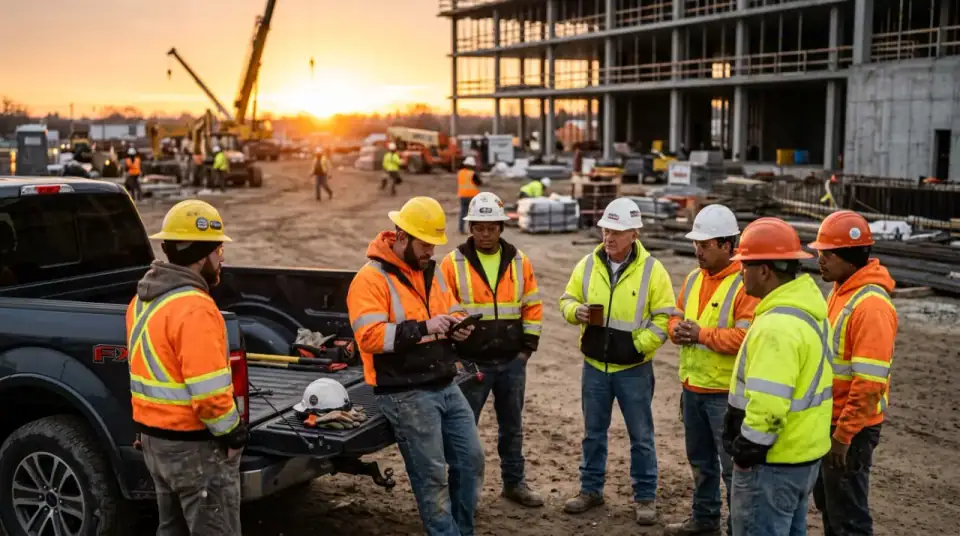 LIVE Toolbox talk · trench safety · 12 signed
AI-generated stand-in photo, not a customer site.
Questions
Something else? Ask a person.
When is a trench box required?
OSHA never requires a box by name. At 5 ft or deeper the trench needs a protective system, and a trench box is one of three: sloping or benching, shoring, or a shield (trench box). Under 5 ft you can go without one only if a competent person checks the ground and sees no sign of a cave-in (29 CFR 1926.652(a)).
What is the OSHA standard for excavations?
29 CFR 1926 Subpart P. 1926.650 covers scope and definitions, 1926.651 the specific requirements (utilities, ladders, air, water, spoils, inspections) and 1926.652 the protective systems. Appendices A to F cover soil types, slopes, timber and aluminum shoring, and how to choose a system.
How often must a competent person inspect a trench?
Every day before work starts, as needed during the shift, and after every rainstorm or other event that makes it more dangerous. The inspection is required whenever workers could reasonably be expected in the trench (1926.651(k)(1)).
How far back do spoils need to be from a trench?
At least 2 ft from the edge, for spoils, materials and equipment, or held back by a retaining device (1926.651(j)(2)). Farther is better. A spoil pile right at the edge loads the wall.
How far apart should ladders be in a trench?
Once the trench is 4 ft deep, every worker has to be within 25 ft of a ladder, stairway or ramp (1926.651(c)(2)). In a long trench that puts them no more than 50 ft apart. The rails stick up 3 ft above the top (1926.1053(b)(1)).
Who can be the competent person for an excavation?
Someone who can spot the hazards that are there and the ones that are coming, and who has the authority to fix them right away (1926.650(b)). The rule doesn't name a course or a card. The employer picks a person trained in soil types, protective systems and Subpart P who can stop the work.

Put an AI foreman on your site.
Tell it about your site. It sets up the rest.