Reading a Site Camera or a Delivery Ticket With AI Costs About a Twentieth of a Cent
We ran 12 AI models over 51 job-site photos and paid the bill ourselves. The model we picked for each photo job costs under $0.0006 a read. On none of the three was the priciest model the pick.
Dozer runs AI on three kinds of job-site photo: a frame from a site camera, a picture of a delivery ticket, and a picture of a serial plate or an hour meter. Before we picked a model for any of them, we built a test out of our own work. It uses the same prompts the app uses, photos we labelled by hand, and checks a foreman would care about, like whether the truck count is right and whether the ticket number has every digit. Then we ran every model that can read a picture and paid the bill. We call it DozerBench. The prompts and photos are ours, so you won’t find these numbers anywhere else.
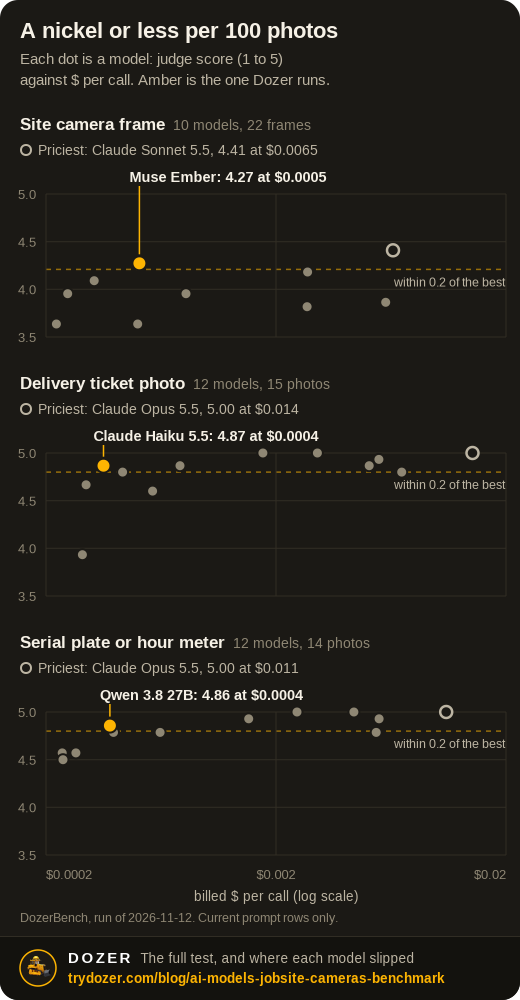
Here’s the short answer. With the right model, reading a site photo correctly costs about a twentieth of a cent. In none of the three photo tests was the priciest model the one we picked. On delivery tickets, Claude Opus 5.5 cost the most and scored a perfect 5.00. Claude Haiku 5.5 scored 4.87 for about a fortieth of the price, and it passed every check.
What we ran
The three photo jobs had 51 test cases between them: 22 camera frames, 15 ticket photos and 14 plates and meters. A third of them are traps. There’s a blurred frame, mud on the lens, a nearly black frame in the middle of a workday, a ticket with a thumb over the weights, a gas station receipt, and a plate with paint over the serial number. On those, a good model has to say “I can’t read this” instead of making something up.
Twelve models that take pictures ran on the ticket and plate tests. Ten ran on the final version of the camera test. A judge model scored each answer from 1 to 5 against the truth we wrote for that photo. The rule for a pick is simple. We take the cheapest model that scores within 0.2 of the best and passes at least 95% of the hard checks.
| Job | Model Dozer runs | Score (best) | Cost per read |
|---|---|---|---|
| Site camera frame | Muse Ember | 4.27 (4.41) | $0.00051 |
| Delivery ticket | Claude Haiku 5.5 | 4.87 (5.00) | $0.00036 |
| Serial plate or hour meter | Qwen 3.8 27B | 4.86 (5.00) | $0.00038 |
That works out to about 5 cents for 100 camera frames and under 4 cents for 100 tickets or plates. Say a camera sends a frame every 15 minutes through an 11-hour day. That’s 44 reads, about 2 cents a day.
The priciest model costs a lot more for a little more score. On tickets, Opus cost $0.014 a read, about 40 times Haiku, for 0.13 more points. On plates and meters, Opus cost $0.011, 29 times Qwen, for 0.14 more. On the final camera test the priciest model was Claude Sonnet 5.5 at $0.0065 a frame, about 13 times Muse Ember, for 0.14 more. Opus didn’t make that last camera round. In the round before it, all 12 models read the same frames with the same prompt, and Opus scored 4.09 at $0.013 a frame. Muse Ember scored 4.36 at $0.00048.
Where the models slipped
An average won’t show you the one bad read that ends up on a pay app. These are real answers from the test, word for word where we quote them.
The pickup at the gate. The gate camera’s job was “tell me when a dump truck comes through the gate.” The frame shows a white pickup crossing the rumble grate and no dump truck. Gemini 4 Argon, at $0.006 a read, wrote “no dump trucks at the gate” and then put 1 in the truck count anyway. It counted the pickup. That’s a false load on your tally. GPT-6 Luna got the count right but turned the camera yellow with nothing wrong. Muse Ember wrote “No dump truck at gate; only a white pickup truck is passing through,” counted zero trucks, and left the camera green.
One truck on the scale. A quarry scale camera at 8:45 in the morning shows one loaded truck on the scale and nobody around. Three models raised a warning for no reason: GPT-6.1 Terra, Gemini 3.5 Flash-Lite and GPT-6 Luna. Claude Haiku 5.5 and Gemini 4 Argon each said two machines were working, and the judge couldn’t find them in the picture. Haiku also added that “the quarry is running normally,” which nothing in the frame shows. Muse Ember wrote “One loaded dump truck is on the scale” and scored 5.
Where our pick got it wrong. One test photo isn’t a camera view at all. It’s a posed photo of a foreman holding a phone, with an excavator behind them. The right answer is “this isn’t the camera’s view, check the camera.” Haiku, Luna, all three Gemini models and Sonnet said so. Muse Ember treated it as the live view, counted four people and scored 2. It’s one photo out of 22, but it’s the mistake we’ll watch for on real footage.
A ticket in metric tonnes. One ticket prints its weights as 33.80 MT gross and 21.60 MT net, and the job needs US tons. Nine of the 12 models returned exactly 37.26 gross and 23.81 net, Haiku and Opus among them. GPT-6 Luna was off by 0.01. Qwen 3.8 27B converted it wrong and gave 23.15 tons net, two thirds of a ton short on one load. GLM 5.3 Flash dropped a digit from the ticket number, reading 0057731 as 005731, and printed the year as 2021.
A thumb over the weights. On a ticket held with a thumb across the gross, tare and net lines, no model guessed a weight, which is the part that matters. But Claude Sonnet 5.5, at 20 times Haiku’s price, still marked the ticket readable. Haiku marked it unreadable and said a finger covered the weights.
One model doesn’t fit every job. Haiku, our ticket pick, read an hour meter showing 2936.4 as 36.4. GPT-6 Luna read the same meter as 2935.4. Qwen 3.8 27B read it right. That’s why plates and meters run on Qwen, and why each job gets its own test.
What this means if you run a site
Paying for the biggest model doesn’t buy you much on photos. A read comes out right when the prompt is tight, the model fits that one job, and the test includes the bad photos you actually get: mud, glare, thumbs and the wrong picture altogether. A score of 4.27 means mostly right, not always right, so check the counts that matter against the frame before they go in a pay app.
Dozer runs these picks on your own cameras. Start free and add your first camera.
How we tested, and what it doesn’t prove
Each model ran through OpenRouter with the exact prompt, answer format and settings the Dozer app uses. Every answer went through hard checks first, like the truck count, the ticket number digit for digit, the converted tons, and whether a bad photo was marked unreadable. Then Claude Sonnet 5.5 judged it. The judge saw the photo, the truth we wrote for it and up to six unnamed answers at once, shuffled for each case, and scored each from 1 to 5. An invented fact capped an answer at 2.
A judge is a model too, so we checked it. GPT-6.1 Sol re-scored a sample of 24 cases from across Dozer’s ten AI jobs, 329 answers in all. The two judges agreed within one point on 96% of them. Sonnet ran a little generous overall and gave Anthropic models 0.19 more than Sol did. For Meta, which makes Muse Ember, the gap was 0.08.
Cost is what OpenRouter billed for each call, read from its response. The whole benchmark, all ten of Dozer’s AI jobs plus judging, cost $52.85. It runs under a $60 cap and stops itself at $56. Every prompt version gets an 8-character hash, and only answers on the current one count. The numbers above come from prompt 6a3ccfbe for camera frames, 49ca3aed for tickets and 2e789740 for plates and meters. Prices are OpenRouter’s at the time of the run, in November 2026, and they change.
Here’s what it doesn’t prove. Fourteen to twenty-two photos per job is a small test. On the same job, one model’s average moved 0.2 to 0.3 points between runs of nearly the same prompt, so a 0.13 gap is a tie, not a win. The camera frames are job-site pictures we labelled by hand, plus blurred, darkened, glared and muddied copies. They aren’t hours of footage from a working site, and real footage hadn’t arrived when this ran. The tickets and plates were drawn by our own code in a headless browser, tilted and set on a background, so they’re cleaner than a crumpled ticket off a dashboard. We’ll rerun when real footage comes in, and the pick will change if the numbers do.