
Pre-task plan (PTP): the crew's plan for today.
Today's tasks, the hazards, a control for each, and every name on it before work starts.
WorkToday: 120 ft of 8-inch sewer, 8 to 10 ft deep, in the trench box
| Hazards |
|---|
| Cave-in while setting and joining pipe |
| Crushed between pipe and the trench wall or box |
| Dropped or rolling pipe |
| Pipe laser beam in the eyes |
Controls
- Work only inside the trench box or a sloped or shored trench.
- Ladder within 25 ft; keep spoils 2 ft back.
- Chock pipe stored on the surface so it can't roll.
- Tag lines and a rated lifting point; nobody under the pipe.
Toolbox talk: Trench ladders and spoil piles
- 1Sign upWith email, Google or Apple.
- 2Tell it about the siteLike you'd tell a new foreman.
- 3It opens, built for your siteJHA & talks, plus crew sign-off on one phone
A pre-task plan (PTP) is the short plan a foreman and crew write at the work spot before the shift's work starts: today's tasks in order, the hazards of each, a control for every hazard, the permits and equipment, and everyone's signature. It's redone when the work or the conditions change. Many general contractors require one every day.
PTP vs JHA vs JSA vs AHA
| Plan | Who writes it | When | Good for | Comes from |
|---|---|---|---|---|
| PTP (pre-task plan) | The foreman, with the crew | Every shift, before work, at the work spot | That shift, or until the task or the conditions change | GC and owner safety programs. No OSHA rule names it. |
| JHA (job hazard analysis) | The super or safety lead, with the people who do the work | Before a kind of work is done the first time | Until the job changes. Reviewed now and then, and after an injury or a close call | OSHA's guide, Publication 3071 |
| JSA (job safety analysis) | Same as a JHA | Same as a JHA | Same as a JHA | Another name for a JHA, common in oil, gas and plant work |
| AHA (activity hazard analysis) | The contractor. The government accepts it | Before each definable feature of work starts | That phase of work, updated as it changes | USACE EM 385-1-1 |
Put simply: the JHA is the template for a kind of work. OSHA's guide calls it "a technique that focuses on job tasks as a way to identify hazards before they occur." The PTP is today's copy of it, with today's crew, today's ground and today's weather written in. Start from a JHA template for the task, then make it about today. On a Corps of Engineers job, the same work goes into the EM 385 activity hazard analysis.
What goes on a pre-task plan
- The date, the site, the exact work area, the foreman, and the competent person when the work needs one (trenches, scaffolds, fall protection).
- Today's tasks, in the order they'll happen.
- The hazards of each task: the ones on this site today, not a generic list.
- A control for each hazard. Get rid of it first, then guard it, then change how the work's done, then PPE.
- Permits and checks before work: the 811 ticket, the trench inspection, a hot work permit or a confined space permit, a lift plan.
- The machines and tools, and their inspections.
- PPE for each task, past the site minimum.
- Emergency: where to meet, the site address, the nearest hospital, who calls 911.
- Stop work: what makes anyone stop and call the foreman.
- Signatures from everyone on the crew, including anyone who shows up late.
A filled PTP: sewer crew in a trench box
A sample earthwork crew laying 8-inch sewer, 8 to 10 ft deep, with an excavator, a trench box, a loader, a plate compactor and a walk-behind saw.
| Task | Hazards | Controls |
|---|---|---|
| 1. Saw-cut the asphalt at the tie-in | Silica dust, kickback, traffic | Walk-behind saw with water on the blade, outdoors: no respirator under silica Table 1. Cones and a flagger per the traffic plan. No dry sweeping. |
| 2. Locate and pothole | Gas and fiber crossing the line | 811 ticket current, marks fresh. Vac or hand dig inside the tolerance zone. Pothole the gas crossing before the bucket gets close. |
| 3. Dig, 8 to 10 ft | Cave-in, struck by the swing, falls | Soil called Type C (sand) by the competent person. Trench box rated for the depth, tab data in the truck. Spoils 2 ft back, far side. Swing radius barricaded. |
| 4. Set and join pipe | Caught between pipe and box, dropped pipe, pipe laser | Work inside the box only. Ladder in the box, within 25 ft. Tag lines, nobody under the pipe. Laser warning sign posted. |
| 5. Backfill and compact | Struck by the loader, compactor at the edge | Spotter for the loader. Compact in lifts. Nobody in the box while it's pulled up. |
| Before work | Trench inspected 6:45 AM by the competent person. Again after any rain. Air tested at the manhole tie-in. |
| Machines | Excavator, loader, plate compactor, walk-behind saw. Walk-arounds done. |
| PPE | Hard hat, Class 2 vest (Class 3 at night), safety glasses, steel toes, gloves. Hearing protection and a face shield on the saw. |
| Emergency | Meet at the trailer. Site address and the nearest ER are on the trailer door. The foreman calls 911. |
| Stop work if | Cracks or water in a trench wall, the box shifts, a line gets hit, or anyone isn't sure. |
| Signed | J. Morales (foreman, competent person), R. Singh, T. Kowalski, A. Lee |
Every line in it points at a rule or a habit. The box, the ladder and the spoils are the OSHA trench rules. The soil call is from the OSHA soil types chart. The saw is row (iv) of OSHA silica Table 1. The rest is from the underground pipe laying JHA and the utility locate JHA.
When to redo the PTP
- A new task that isn't on it.
- The ground or the weather changes: rain overnight, a thaw, water in the trench.
- The work goes past what the plan covered: deeper than the box is rated for, a new utility in the way.
- A new machine on the task. A new person reads it and signs before they start.
- A near miss, or someone hits something. Write that up in an incident report too.
- The next shift. Yesterday's PTP isn't today's.
Redoing it takes two minutes: add the change, talk it through, everyone signs again.
Make it worth the paper
- Write it at the work, not in the trailer. Look at the ground you're about to dig.
- Short beats long. The tasks for today and the hazards that can actually hurt someone today.
- Have the crew say the hazards back. If they can't, it wasn't a plan.
- Pair it with a two-minute toolbox talk on the biggest hazard of the day.
A pre-task plan in Dozer
Say the day's work, the way you'd tell the crew. Dozer writes the JHA for it: the steps in order, the hazards and controls for each, the PPE, the permits and checks before work starts, when to stop work, and a two-minute toolbox talk. That's today's pre-task plan. The crew signs on one phone, and the PDF is filed with the site. A competent person reviews and signs every JHA. For the bigger picture, the site-specific safety plan names who's responsible on the job.
Sources
Read on 2026-11-15.
A starting point, not legal or safety advice. Your GC's program and the competent person on site have the final word.
Tomorrow, the crew signs it on one phone.
Dozer writes the JHA and the toolbox talk from what you say about the work.
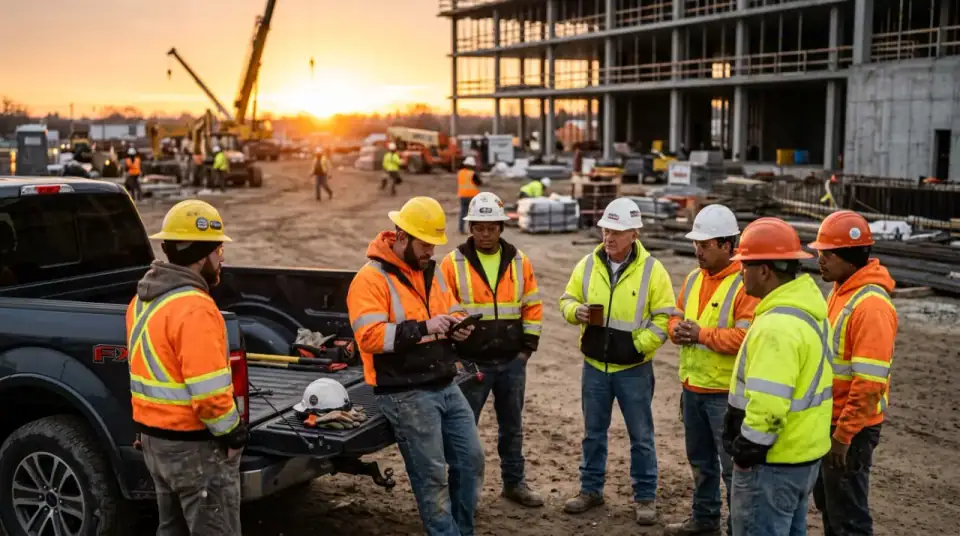 LIVE Toolbox talk · trench safety · 12 signed
AI-generated stand-in photo, not a customer site.
Questions
Something else? Ask a person.
Is a pre-task plan required by OSHA?
No OSHA rule calls for a document named a pre-task plan. OSHA does require much of what goes on one for certain work: a competent person's trench inspection, fall protection, silica controls, confined space permits. Many general contractors and owners require a signed PTP every shift, and USACE jobs use the activity hazard analysis (AHA) from EM 385-1-1.
What is the difference between a PTP and a JHA?
A JHA covers a kind of work and lasts until that work changes. A PTP covers today's tasks with today's crew, ground and weather, and lasts one shift. Most crews build the day's PTP from the JHA for the work.
Who fills out a pre-task plan?
The foreman or crew lead, with the crew, at the work spot. Everyone who does the work signs it. When the work needs a competent person, like a trench 5 ft or deeper, they review it too.
How often should a pre-task plan be done?
Every shift before work starts, and again whenever the task or the conditions change: new work, rain, a new person on the crew, a near miss.
What is a PTP in construction?
A pre-task plan: a one-page plan for the shift with the tasks in order, the hazards of each, a control for each hazard, the permits and equipment, the emergency plan and the crew's signatures.
Is a JSA the same as a pre-task plan?
Close, but not quite. A JSA (the same thing as a JHA) is written once for a kind of work. A PTP is written for today. Some companies call their daily form a daily JSA. What matters is that it's done before work, at the work, and signed.
Put an AI foreman on your site.
Tell it about your site. It sets up the rest.