OSHA silica Table 1, row by row.
Find your tool. Use every control in the row. Wear the respirator the hours call for.
WorkSaw-cut 60 ft of slab outdoors, handheld saw, about 5 hours
| Hazards |
|---|
| Silica dust from concrete, block, brick and stone |
| Kickback and blade contact |
| Noise |
| Electric shock from cords and water |
Controls
- Water on the blade (OSHA Table 1).
- Handheld saw outdoors over 4 hours a shift, or any time indoors: wear an APF 10 respirator (Table 1).
- Blade guard on. Right blade for the material; check it for cracks.
- Two hands on a handheld saw. Stand out of the line of the blade.
Toolbox talk: Silica dust
- 1Sign upWith email, Google or Apple.
- 2Tell it about the siteLike you'd tell a new foreman.
- 3It opens, built for your siteJHA & talks, plus crew sign-off on one phone
Table 1 of OSHA's construction silica rule, 29 CFR 1926.1153(c), lists 18 tools and tasks. For each one it sets the dust control (water at the blade, a shroud and vacuum, or an enclosed cab) and the respirator, if any, for 4 hours or less and more than 4 hours a shift. Follow your row fully and you don't have to measure exposure.
Table 1, in plain words
Every tool row also says: run and maintain the tool the way the maker says, to keep the dust down. The ≤ 4 h and > 4 h columns are the respirator for 4 hours or less and for more than 4 hours a shift. APF is its assigned protection factor; "None" means no respirator is required.
| Tool or task | Where | ≤ 4 h | > 4 h | Controls |
|---|---|---|---|---|
| Stationary masonry saws Row (i) | Any | None | None | Saw with a built-in water system that keeps water on the blade. |
| Handheld power saws (any blade size) Row (ii) | Outdoors | None | APF 10 | Saw with a built-in water system that keeps water on the blade. |
| Indoors or enclosed | APF 10 | APF 10 | ||
| Handheld saws cutting fiber-cement board (blade 8 in or less) Row (iii) | Outdoors only | None | None | Saw with a dust collection system: the maker's airflow or more, a filter 99% or better. |
| Walk-behind saws Row (iv) | Outdoors | None | None | Saw with a built-in water system that keeps water on the blade. |
| Indoors or enclosed | APF 10 | APF 10 | ||
| Drivable saws Row (v) | Outdoors only | None | None | Saw with a built-in water system that keeps water on the blade. |
| Rig-mounted core saws or drills Row (vi) | Any | None | None | Tool with a built-in water system feeding the cutting surface. |
| Handheld and stand-mounted drills (impact and rotary hammer too) Row (vii) | Any | None | None | Shroud or cowling with dust collection: the maker's airflow or more, a filter 99% or better with a filter cleaner. HEPA vacuum to clean the holes. |
| Dowel drilling rigs for concrete Row (viii) | Outdoors only | APF 10 | APF 10 | Shroud around the bit with dust collection, a filter 99% or better with a filter cleaner. HEPA vacuum to clean the holes. |
| Vehicle-mounted drilling rigs for rock and concrete Row (ix) | Any | None | None | Dust collector with a close-capture hood or shroud around the bit, and a low-flow water spray at the collector's discharge. Or run it from an enclosed cab with water on the bit. |
| Jackhammers and handheld powered chipping tools Row (x) | Outdoors | None | APF 10 | Water spray or stream at the point of impact. Or a shroud with dust collection: the maker's airflow or more, a filter 99% or better with a filter cleaner. |
| Indoors or enclosed | APF 10 | APF 10 | ||
| Handheld grinders for mortar removal (tuckpointing) Row (xi) | Any | APF 10 | APF 25 | Shroud with dust collection: 25 cfm or more per inch of wheel, a filter 99% or better, and a cyclonic pre-separator or filter cleaner. |
| Handheld grinders, any other use Row (xii) | Outdoors only | None | None | Grinder with a built-in water system feeding the grinding surface. |
| Outdoors | None | None | Or a shroud with dust collection: 25 cfm or more per inch of wheel, a filter 99% or better, and a cyclonic pre-separator or filter cleaner. | |
| Indoors or enclosed | None | APF 10 | ||
| Walk-behind milling machines and floor grinders Row (xiii) | Any | None | None | Built-in water feeding the cutting surface. Or the maker's dust collection system: its airflow or more, a filter 99% or better with a filter cleaner. Indoors, HEPA-vacuum loose dust between passes. |
| Small drivable milling machines (less than half-lane) Row (xiv) | Any | None | None | Extra water sprays built to knock down dust, with a surfactant in the water. |
| Large drivable milling machines (half-lane and up) Row (xv) | Any | None | None | Asphalt, any depth: exhaust ventilation on the drum enclosure plus extra water sprays. Any material, 4 in deep or less: the same, or extra water spray with a surfactant. |
| Crushing machines Row (xvi) | Any | None | None | Water spray or mist at the crusher and every dust point: hoppers, conveyors, screens, discharge. Operator in a ventilated booth with fresh, climate-controlled air, or at a remote control station. |
| Heavy equipment breaking silica material: hoe-ramming, rock ripping, demolition Row (xvii) | Any | None | None | Run it from an enclosed cab. When anyone outside the cab works the task, water or dust suppressant as needed. |
| Heavy equipment grading and excavating (not breaking silica material) Row (xviii) | Any | None | None | Water or dust suppressant as needed. Or, when the operator is the only one on the task, run it from an enclosed cab. |
29 CFR 1926.1153 Table 1, read on the eCFR on 2026-11-15. Plain words are ours; the controls and the APFs are the rule's.
How to use your row
- All of it, not some of it. The row only counts if every control in it is in place and working: the water flowing, the shroud on, the vacuum the right size. Otherwise you're off Table 1 (1926.1153(c)(1)).
- Add up the hours. Count every Table 1 task a worker does that shift. Over 4 hours total, and every task takes the over-4-hours column (1926.1153(c)(3)).
- Indoors is stricter. Indoors or in an enclosed area, give the dust a way out with exhaust as needed (1926.1153(c)(2)(i)).
- Enough water. Wet methods need enough flow to keep visible dust down (1926.1153(c)(2)(ii)).
- Cabs and booths that count. Kept free of settled dust, door seals and gaskets working, under positive pressure with fresh air, intake filtered at 95% for 0.3 to 10 µm (MERV-16 or better), with heat and air conditioning (1926.1153(c)(2)(iii)).
- No dry sweeping or blowing off. Wet sweep or HEPA-vacuum. Compressed air on clothes or surfaces only with a system that captures the dust, or when nothing else works (1926.1153(f)).
What the APFs mean. APF 10 is at least a half-mask respirator, which includes a fit-tested filtering facepiece like an N95. APF 25 is at least a loose-fitting powered air-purifying respirator (PAPR); a full-facepiece respirator (APF 50) also covers it. A required respirator means a respiratory protection program, with fit testing and training (1926.1153(e); 1910.134). A worker who has to wear one 30 or more days a year is offered a medical exam at no cost, within 30 days of starting and every 3 years after (1926.1153(h)).
When you're off Table 1
A task that isn't on the list, or a Table 1 tool without its full row, puts you on the other path, 1926.1153(d):
- The limit is 50 µg/m³ of respirable crystalline silica, averaged over 8 hours. The action level is 25 µg/m³.
- Assess each worker's exposure at or above the action level, either with air monitoring or objective data (the performance option), or with scheduled monitoring.
- Scheduled monitoring repeats within 6 months when results are between 25 and 50, and within 3 months when they're over 50. Two results in a row below 25, at least 7 days apart, and you can stop.
- Tell the workers the results in writing, or post them, within 5 working days. Over the limit, say what you're doing about it.
- Engineering and work-practice controls come first. Respirators fill the gap when they aren't enough.
The whole rule only applies where exposure could reach 25 µg/m³ over 8 hours under any foreseeable conditions (1926.1153(a)). Cutting, grinding, drilling and breaking concrete, block, brick and stone are what Table 1 is built around. A quarry or a mine is under MSHA, not this rule; that's the MSHA Part 46 world.
The written exposure control plan
Every employer under the rule needs one, Table 1 or not (1926.1153(g)). It has to say, at least:
- The tasks on your jobs that make silica dust.
- For each task, the engineering controls, work practices and respirators.
- The housekeeping: how you clean up without making more dust.
- How you keep people out of the dust when you need to, including other trades and other employers' crews.
Review it at least once a year and update it. Anyone it covers can ask to see it. And name a competent person to inspect the jobs, the materials and the equipment often enough to make the plan real on site.
Dozer doesn't write the plan. It does the daily part: say the day's cutting or drilling, and the JHA comes back with the Table 1 controls for that tool, the respirator if the row calls for one, and a silica dust toolbox talk for the crew to sign on one phone. A competent person reviews and signs every JHA. If a site camera catches heavy dust, the board marks it for someone to look.
Table 1 tasks with a JHA template
- Saw cutting JHA: rows i, ii, iv and v
- Core drilling JHA: row vi
- Grinding and chipping concrete JHA: rows x and xii
- Rock drilling JHA: row ix
- Asphalt milling JHA: rows xiv and xv
- Masonry JHA: row i, the masonry saw
- Curb, gutter and sidewalk JHA: saw-cut joints, rows ii and iv
- Demolition JHA: row xvii
- Grading JHA: row xviii, water for the dust
Saw-cutting pavement over a trench? The trench safety rules cover the rest of that job, and the pre-task plan puts the saw and the trench on one page for the crew.
Sources
Read on the eCFR on 2026-11-15 (current through 2026-11-12).
- 29 CFR 1926.1153, respirable crystalline silica (construction)
- 29 CFR 1910.134, respiratory protection (Table 1, assigned protection factors)
A starting point, not legal or safety advice. Check your tool against the rule's own Table 1 and the maker's instructions.
Tomorrow, the crew signs it on one phone.
Dozer writes the JHA and the toolbox talk from what you say about the work.
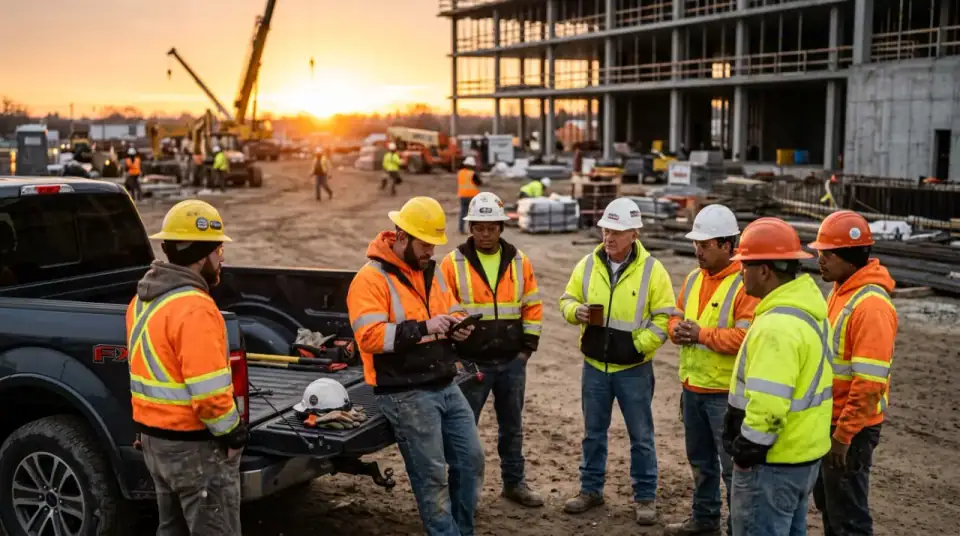 LIVE Toolbox talk · trench safety · 12 signed
AI-generated stand-in photo, not a customer site.
Questions
Something else? Ask a person.
What is Table 1 in the OSHA silica standard?
The list in 29 CFR 1926.1153(c) of 18 construction tools and tasks, from handheld saws to crushers and heavy equipment. For each one it names the dust controls and the respirator, if any, for 4 hours or less and more than 4 hours a shift. Follow your row fully and you don't have to measure the crew's exposure.
Do I need a respirator to cut concrete outdoors?
With a handheld saw and water on the blade: no respirator for 4 hours or less a shift, APF 10 for more than 4. With a walk-behind or drivable saw and water on the blade outdoors: none at all. Indoors or in an enclosed area, a handheld or walk-behind saw needs APF 10 from the first minute.
What does APF 10 mean?
An assigned protection factor of 10: at least a half-mask respirator, which includes a fit-tested filtering facepiece like an N95, under a respiratory protection program (29 CFR 1910.134). APF 25 means at least a loose-fitting powered air-purifying respirator (PAPR).
How are the 4 hours counted?
All Table 1 tasks a worker does in the shift, added up. If the total is more than 4 hours, every task uses the more-than-4-hours respirator column (1926.1153(c)(3)).
What if my task isn't on Table 1?
Then you assess the crew's exposure, by air sampling or objective data, keep it at or below 50 µg/m³ over 8 hours with engineering controls first, and add respirators where those aren't enough (1926.1153(d)). The same applies if you use a Table 1 tool but don't follow its row fully.
Do I still need a written exposure control plan if I follow Table 1?
Yes. Table 1 replaces the exposure measuring, not the plan. The plan lists the tasks, the controls and respirators for each, the housekeeping and how you keep other people out, names a competent person, and is reviewed every year (1926.1153(g)).
Put an AI foreman on your site.
Tell it about your site. It sets up the rest.