Safety stand-down kit for construction crews.
Stop the work, talk one hazard, walk the site, fix what you find.
- 0 to 3 min: Stop the work
- 3 to 8 min: Why we stopped: the topic, and a real story
- 8 to 18 min: The talk: read it out, point at the real thing on site, ask the questions and wait for answers
- 18 to 26 min: Walk the site in pairs and look for the hazard on this job
- 26 to 30 min: Read back what was found
29 CFR 1926.502(b); 29 CFR 1926.502(i)
- 1Sign upWith email, Google or Apple.
- 2Tell it about the siteLike you'd tell a new foreman.
- 3It opens, built for your siteJHA & talks, plus crew sign-off on one phone
A safety stand-down is a planned break in work, usually 30 minutes to an hour, where the whole crew stops to talk about one hazard, walk the site looking for it and fix what they find. OSHA runs a national stand-down for falls each spring and NUCA one for trenches in June. Below is a 30-minute kit for an earthwork crew.
National stand-downs on the calendar
| Stand-down | When |
|---|---|
| National Stand-Down to Prevent Struck-by Incidents in Construction Struck-by: backing trucks, swing radius, work zones | The week of National Work Zone Awareness Week in April (April 20-24 in 2026) |
| Construction Safety Week Any hazard; site-wide events | May 3-7, 2027 |
| OSHA National Safety Stand-Down to Prevent Falls in Construction Falls | May 4-8 in 2026, its 13th year; 2027 dates not posted when we checked |
| NUCA Trench Safety Stand Down Trenches and excavations | June 15-19 in 2026 |
| OSHA Safe + Sound Week The safety program: leadership, crew input, find and fix | August 9-15, 2027 |
Why falls get their own week: in 2024, falls, slips and trips killed 389 of the 1,034 construction workers who died on the job, more than a third (BLS). The month pages put these weeks on the schedule: April for struck-by, May for falls, June for trenches.
A 30-minute stand-down agenda
| Minutes | What happens |
|---|---|
| 0 to 3 | Stop the work. Machines parked with buckets and blades down. Everyone gathers where they can see the hazard. Who: Foreman |
| 3 to 8 | Why we stopped: the topic, and a real story. A near miss on this job beats any statistic. Who: Superintendent or foreman |
| 8 to 18 | The talk: read it out, point at the real thing on site, ask the questions and wait for answers. Who: Foreman, then the crew |
| 18 to 26 | Walk the site in pairs and look for the hazard on this job. Write down every spot. Who: The crew |
| 26 to 30 | Read back what was found. Name who fixes each one and by when. Everyone signs. Who: Foreman |
Hold it where the hazard is: at the edge, at the trench, behind the truck. Get the subs and the drivers in too; the stand-down is for everyone on the job that day.
The fall talk
Read the fall protection toolbox talk first:
- Top rail at 42 in, give or take 3 in, with a midrail.
- A guardrail holds 200 lb pushed out or down.
- Hole covers hold twice the load, are secured and say HOLE or COVER.
- Skylights are holes. Cover or guard them.
- Remove a guardrail only to work, and put it back right away.
Then everyone lays out their harness and goes through the harness check: the webbing, stitching, buckles and D-ring, and the lanyard's shock pack. Finish with fall rescue, so everyone knows how a person hanging in a harness gets down fast, and ladder setup if ladders are the main way up on your job.
The trench version
For a utility or earthwork crew, trenches may be the bigger risk. Run the same agenda with the trench safety toolbox talk:
- At 5 ft or deeper, the trench needs a box, shoring or a slope. Over 20 ft, an engineer designs it.
- Use the box's tab data: depth rating and how it's stacked.
- Stay inside the box. Never stand between the box and the trench wall.
- Get in and out by the ladder inside the box, within 25 ft of you.
- Nobody in the box while it's being moved.
Add the cave-in warning signs, trench ladders and spoil piles and calling 811, then walk every open trench with the competent person.
The struck-by version
For a site full of trucks and machines, use backing and blind spots, swing radius and spotters and the heavy equipment safety talk. On the walk, stand where a driver can't see you, so the crew learns the blind spots for real.
What to look for on the walk
- Every edge or hole 6 feet or more above a lower level: a guardrail, a cover or a harness tied off (29 CFR 1926.501(b)(1)).
- Every ladder: 1 out for 4 up, 3 feet over the landing, tied off, not damaged.
- Every trench 5 feet or deeper: a box, shoring or a slope, and the competent person's daily check (29 CFR 1926.652(a)(1), 1926.651(k)).
- Trench exits within 25 feet of every worker at 4 feet deep, and spoils 2 feet back from the edge.
- Where trucks back up: who spots, and whether the backup alarms work.
- The swing radius on every excavator: barricaded or marked.
- Overhead lines near any boom, bed or mast: 10 feet up to 50 kV.
- Harnesses and lanyards: webbing, stitching, D-ring, the shock pack.
Sign-in sheet and fix list
| Name | Company | Signature |
|---|---|---|
| What we found | Who fixes it | By when |
|---|---|---|
OSHA's certificate of participation
After a fall stand-down, OSHA's certificate form asks for your business name, state, industry, how many workers took part and how many years you've joined, with optional feedback. It then makes a printable certificate of participation in English or Spanish. It's optional. When we read it on 2026-11-15, the form still named the 2025 event; OSHA updates it for each year's stand-down. OSHA also asks crews to share their stand-down by email or with #StandDown4Safety.
When to call your own stand-down
You don't need a national week. Stop the job after a serious injury or a near miss worth writing up, before a new phase of work, when the same hazard keeps turning up, or on the first day back after a long break. Write it up in the daily report with what was found and fixed. Teach stop work authority at the stand-down, so anyone can call a stop before the next one is needed. The Focus Four talk works for a stand-down that covers all four big hazards at once.
Dozer opens the fall talk in the app. Read it out, the crew signs on one phone, and the stand-down is logged with the day.
Send the stand-down talk to my crewA starting point, not legal or safety advice. Plan the stand-down for your site and your crew, and follow your company's safety plan and the competent person.
Sources
Read on 2026-11-15. Rules are 29 CFR as published on eCFR.
- OSHA, National Safety Stand-Down to Prevent Falls
- OSHA, stand-down certificate of participation
- NUCA, Trench Safety Stand Down
- CPWR, struck-by stand-down
- Construction Safety Week, FAQ
- OSHA, Safe + Sound Week
- BLS, Census of Fatal Occupational Injuries 2024, table A-9
- BLS, The Economics Daily (May 5, 2026)
- 29 CFR 1926.501(b)(1)
- 29 CFR 1926.652(a)(1)
Tomorrow, the crew signs it on one phone.
Dozer writes the JHA and the toolbox talk from what you say about the work.
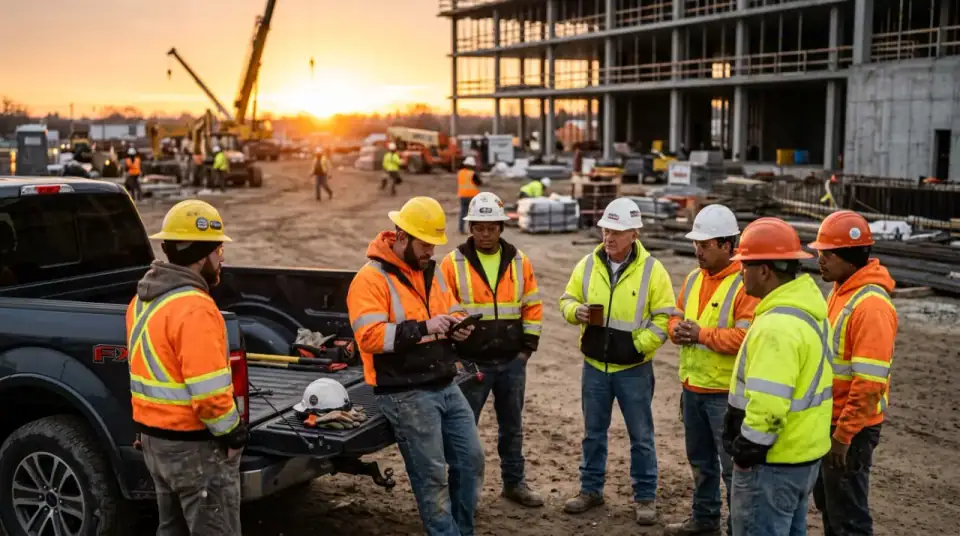 LIVE Toolbox talk · trench safety · 12 signed
AI-generated stand-in photo, not a customer site.
Questions
Something else? Ask a person.
What is a safety stand-down?
A planned break in work where the whole crew stops to talk about one hazard, look for it on the job and fix what they find. OSHA calls its fall stand-down "a voluntary event for employers to talk directly to employees about safety."
When is the National Safety Stand-Down to Prevent Falls?
OSHA held the 13th one May 4-8, 2026. OSHA hadn't posted the 2027 dates when we checked on 2026-11-15. Construction Safety Week 2027 is May 3-7.
How do I get an OSHA stand-down certificate?
After your stand-down, fill in OSHA's certificate form: business name, state, industry, how many workers took part and how many years you've joined, plus optional feedback. It makes a printable certificate of participation in English or Spanish.
What happens during a safety stand-down?
Work stops, the crew hears one talk, walks the site looking for that hazard, and leaves with a list of fixes and who owns each one. Everyone signs in.
How long is a safety stand-down?
There's no set length. Thirty minutes to an hour works for most crews: long enough to talk, walk the site and make a fix list, short enough to happen.
Can a company hold its own stand-down?
Yes, any day. Good times: after a serious injury or a near miss, before a new phase of work like the first deep trench, when the same hazard keeps showing up, or the first day back after a long break.
Put an AI foreman on your site.
Tell it about your site. It sets up the rest.