Hard hat detection on your site cameras.
Dozer reads each camera picture and flags anyone without a hard hat.
People3
Without a hard hat1
Machines working1 excavator
- On the site's day and the board's ticker
- In tonight's daily report draft
- People counted, never named
- 1Sign upWith email, Google or Apple.
- 2Tell it about the siteLike you'd tell a new foreman.
- 3It opens, built for your siteCameras, plus the office board and after-hours alerts
AI hard hat detection looks at a camera image and flags anyone without a hard hat. Dozer does it on the still pictures your site cameras send, not on live video. When it sees someone bare-headed, that camera's card turns yellow with one plain line, on the site's day and the office board. It counts people. It never names them.
What Dozer marks on a camera picture
Each picture Dozer reads gets one of four colors and a sentence a foreman would say. Each camera has a note that tells Dozer what to look for. When you set up the site, Dozer asks what to watch for; pick hard hats and vests, and the note says to look for anyone without one.
| Color | When it shows |
|---|---|
| Green · active | Work going on, nothing that needs a look. “Two people in the trench box, hard hats on.” |
| Yellow · warning | A hazard that needs a look: no hard hat where the camera watches for one, a machine down, a gate open after hours. “One of three people at the trench has no hard hat.” |
| Red · critical | Danger now: fire, flooding, a collapse, someone hurt. “Smoke and flames by the fuel tank.” |
| Gray · offline | It can't see: the picture is black, frozen or blocked. “Mud on the lens. Check the camera.” |
The sample lines are examples of the format, not real sites.
How a picture becomes a flag
- The camera sends a still. Any camera that can email a picture gets its own Dozer address and sends on motion or on a timer. Reolink, Hikvision and Axis take about five minutes.
- Dozer stores it privately. It shrinks the picture to 2,048 pixels, strips the metadata, and keeps it where only your company can see it.
- A vision model reads it, at most once a minute per camera, against that camera's note. It writes one sentence and up to 12 counts, like people, trucks and machines.
- Yellow and red become events on the site's day and the board's ticker, and they go into the next daily report draft. The camera's card on the office TV board shows its latest line and color.
- The pictures stay on the site for as long as its plan keeps them, then they are deleted. See pricing.
What it can't do
- It isn't video. If someone takes their hard hat off between two pictures, Dozer won't see it.
- It can't see what the camera can't. People far away, behind a machine, in the dark, or behind glare or mud are hard to read. A picture it can't read goes gray and says why.
- It reads what's on people, not what's certified. A hard hat on or off, a vest when you ask. Not hard hat type or date, vest class, glasses, gloves, or a harness that's tied off.
- It doesn't know who anyone is. The model counts people only as a number and is told never to describe a face. Dozer has no face recognition.
- It doesn't make noise. No siren, no speaker. Somebody on site still has to walk over.
- It isn't perfect. In our own test of 12 AI models on job-site photos, the model Dozer runs on camera frames scored 4.27 out of 5. That's mostly right, not always right.
- It doesn't replace the foreman or the competent person, and a flag isn't a safety record.
Video analytics vs still pictures
There are three ways to put AI on site cameras. Each fits a different job.
| Approach | Watches | How fast | Needs | Good for |
|---|---|---|---|---|
| Video analytics | Every frame of a live stream | Seconds | Steady power and bandwidth, or a box on site | One spot that needs watching every second, like a busy gate |
| A camera company's AI | Its own cameras, through its own service | Depends on the plan | Its camera, bought or leased, and its monthly plan | A site that wants the camera, service and AI on one bill |
| Still pictures read by AI (Dozer) | A picture from any camera that can email one, read up to once a minute | Minutes | Any camera that can email a picture, even a 4G or solar one | A second set of eyes on a few cameras, tied to the JHA and the daily report |
If one spot needs watching every second, video analytics is the better tool. If you want a cheap second set of eyes on a few cameras, with the flags landing next to the JHA and the daily report, still pictures do the job. For who sells what, with prices, read the best jobsite camera software for a small contractor.
The hard hat rule
OSHA requires head protection wherever falling or flying objects, bumps, or electrical shock and burns can hurt someone's head, and the hard hat has to meet ANSI Z89.1 (29 CFR 1926.100, read 2026-11-15). A camera flag is a good reason for a five-minute hard hat toolbox talk the next morning, or one on high-vis. For trench work, the trenching JHA lists the PPE with the rest of the controls.
Set it up
Sign up and tell Dozer about the site in your own words. When it asks what to watch for, pick hard hats and vests. It builds example cameras for the spots you named, then you connect a real camera in each one's place and it keeps the same watch. Any camera that can email a picture works; see jobsite cameras for the ways to connect one.
A second set of eyes, not a safety program. A competent person still runs the site, and you decide what to do about a flag.
Then Dozer watches the cameras so you don't have to.
Each camera feeds the site's page in the app.
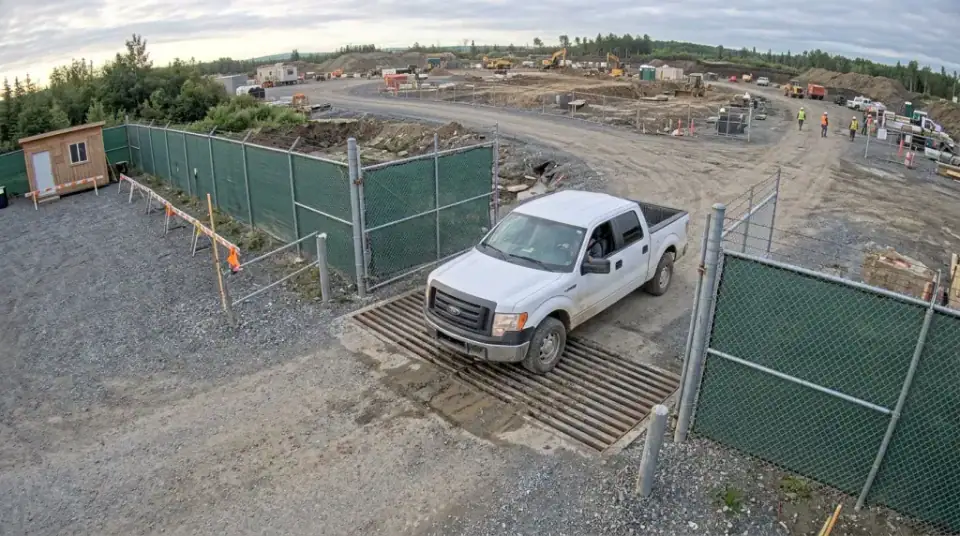 LIVE 6:38 AM · Truck at the gate, no ticket photo
AI-generated stand-in photo, not a customer site.
Questions
Something else? Ask a person.
Can AI detect hard hats on a construction site camera?
Yes, within limits. A vision model can tell a person with a hard hat from one without in a clear picture. It struggles when people are far away, half hidden, in the dark or behind glare. Dozer marks those pictures gray and says why instead of guessing.
Does Dozer use live video for PPE detection?
No. Dozer reads the still pictures your cameras send, up to one a minute per camera. That's cheaper and works on any camera that can email a picture, but it misses what happens between pictures. If you need every second watched, use video analytics.
Does hard hat detection use face recognition?
Not in Dozer. The model is told to count people only as a number and never to identify or describe a face. Dozer has no face recognition. See security.
What cameras work for hard hat detection in Dozer?
Any camera that can email a picture, like Reolink, Hikvision and Axis. Each one gets its own Dozer address, which takes about five minutes. Here's how for a Reolink.
Does it check vests, glasses and harnesses?
It looks for a hard hat and a vest when the camera is set to watch for them, and says what it can see in the picture. It doesn't check hard hat type, vest class, glasses, gloves, or whether a harness is tied off.
Does it sound an alarm on site?
No. There's no siren or talk-down speaker. A flag shows on the site's page in the app and on the office board, and someone on site still has to walk over.
Put an AI foreman on your site.
Tell it about your site. It sets up the rest.