February safety topics for construction crews.
Freeze and thaw, slush, heavy wet loads and torches. Four talks.
- Week 1: Cave-in warning signs
- Week 2: Slips and trips
- Week 3: Lifting without hurting your back
- Week 4: Hot work fire watch
Ask the crew: Where on this site today does "cave-in warning signs" matter most?
Freeze and thaw, slush and mud, heavy wet loads, torches on frozen pipe
- 1Sign upWith email, Google or Apple.
- 2Tell it about the siteLike you'd tell a new foreman.
- 3It opens, built for your siteJHA & talks, plus crew sign-off on one phone
February safety topics for a construction crew: freeze and thaw that loosen trench walls, slush and ice on every walkway, heavy wet loads that hurt backs, and torches used to thaw frozen pipe and ground. Below are four weekly toolbox talks for February, backups, the hazards that change this month, and the dates to plan around.
Four weekly talks for February
Week 1: Cave-in warning signs
Freeze and thaw open cracks in trench walls and spoil piles. A wall that held while frozen can slough once the sun hits it.
On site: Walk the trench edge with the crew and point at any crack, bulge or wet spot. Name today's competent person.
The talk: Cave-in warning signs, 5 points in about 5 minutes. It goes with the excavation and earthwork JHA.
Week 2: Slips and trips
Slush in the day, ice by morning, mud everywhere. Walkways are at their worst, and a fall on flat ground still breaks wrists and backs.
On site: Point at the worst walkway and the salt or sand bucket. Kick the mud off at the trailer and machine steps.
The talk: Slips and trips, 4 points in about 5 minutes. It goes with the working in cold JHA.
Week 3: Lifting without hurting your back
Wet and frozen material is heavier and slicker: frozen pipe, wet forms, bags of sand and salt. Cold, stiff muscles strain easier.
On site: Point at today's heaviest hand-carried item and decide out loud: the machine, two people or one.
The talk: Lifting without hurting your back, 4 points in about 5 minutes. It goes with the material handling and manual lifting JHA.
Week 4: Hot work fire watch
Torches come out to thaw frozen pipe, hydrants and ground. Heating is hot work: move or cover what can burn, keep an extinguisher right there, and post a fire watch when normal precautions aren't enough (29 CFR 1926.352).
On site: Point at the next spot that needs thawing and what can catch: tarps, insulation, dry grass, the fuel cans.
The talk: Hot work fire watch, 4 points in about 5 minutes. It goes with the hot work and welding JHA.
Backup talks for February
A fifth week, a rained-out day or a crew that already heard one of the four: use these.
- Cold stress: It's still cold, and wet cold pulls heat out fast.
- Carbon monoxide: Heaters and gas pumps in trenches and enclosures.
- Three points of contact: Ice and mud on machine steps and tracks.
- First aid and the nearest ER: Check the kit, the AED and the site address for 911.
What changes on site in February
| Hazard | What the crew does | Rule or source |
|---|---|---|
| Freeze-thaw trench walls | Inspect before every shift and after every thaw. Cracks, bulges or sloughing: everyone out. | 29 CFR 1926.651(k)(1) |
| Slush, mud and ice | Salt or sand walkways, clear machine steps, keep hoses and cords out of the walkway. | Good practice |
| Heavy, wet loads | Use the machine or a second person. Keep it close and turn with your feet. | Good practice |
| Torch thawing | Treat it as hot work: clear what can burn, extinguisher in reach, fire watch when needed. | 29 CFR 1926.352 |
| Heaters | Fresh air, level footing, 10 feet from tarps. | 29 CFR 1926.154 |
Dates on the February calendar
| When | What | Use it for |
|---|---|---|
| February 1, 2027 | OSHA 300A goes up | Last year's summary is posted where notices go and stays up until April 30. |
| February 15, 2027 (Monday) | Washington's Birthday, a federal holiday | A short week for some crews. Plan the talk for a full-crew day. |
| By March 2, 2027 | 300A online submission deadline | Do it in February so March 2 isn't a scramble. |
Each date links its source, read on 2026-11-15. Organizers set some of these weeks fresh each year. A date marked "worked out" comes from the organizer's published rule, not an announcement; check the source before you plan around it.
February sign-in sheet
One sheet for the month: a row per person, a column per weekly talk. Keep it with the JHAs; it's your record that the training happened (29 CFR 1926.21(b)(2)).
| Name | Wk 1 | Wk 2 | Wk 3 | Wk 4 |
|---|---|---|---|---|
Dozer opens week 1's talk, Cave-in warning signs, in the app. Read it out, the crew signs on one phone, and it's logged with the day.
Send the first talk to my crewA starting point, not legal or safety advice. Match each talk to today's work on your site, and follow your company's safety plan and the competent person.
Safety topics for other months
Last month: January safety topics. Next month: March safety topics. The whole year is on the monthly safety calendar. For a one-minute topic any day, use the safety moments, and to stop the whole job for a longer session, run a safety stand-down.
January · March · April · May · June · July · August · September · October · November · December
Sources
Read on 2026-11-15. Rules are 29 CFR as published on eCFR.
Tomorrow, the crew signs it on one phone.
Dozer writes the JHA and the toolbox talk from what you say about the work.
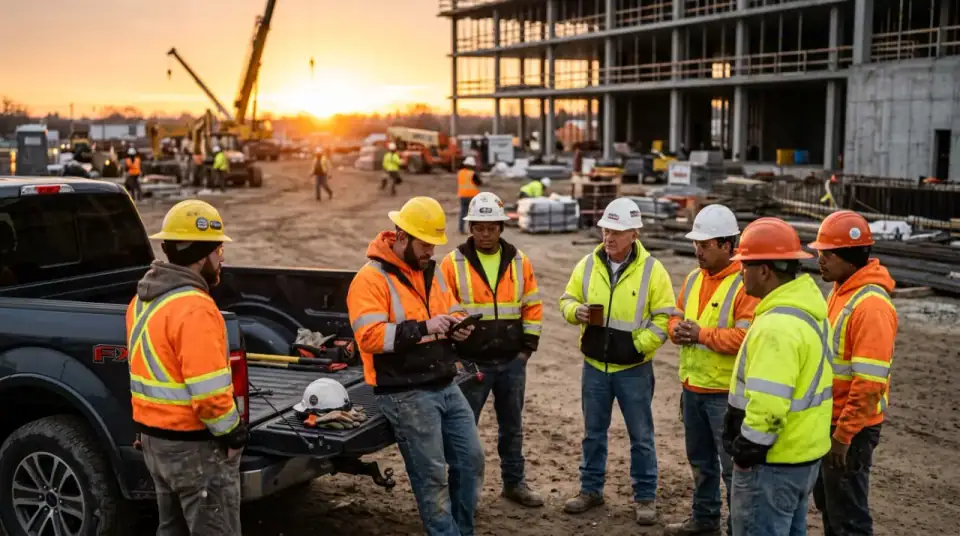 LIVE Toolbox talk · trench safety · 12 signed
AI-generated stand-in photo, not a customer site.
Questions
Something else? Ask a person.
What are good safety topics for February?
Freeze-thaw and cave-in warning signs, slips and trips on slush and ice, safe lifting of heavy wet loads, and fire watch for torch thawing. Backups: cold stress, carbon monoxide, three points of contact and first aid.
Why do trench walls fail in a thaw?
Frozen ground holds together, then loses that strength as it thaws, and meltwater soaks in. That's why the competent person inspects after every thaw, the same as after a rainstorm (29 CFR 1926.651(k)(1)).
Is thawing pipe with a torch hot work?
Yes. Heating with a torch falls under the welding and cutting fire rules: move or cover what can burn, keep an extinguisher ready, and post a fire watch when the normal precautions aren't enough (29 CFR 1926.352).
How long does the OSHA 300A stay posted?
From February 1 until April 30 (29 CFR 1904.32(b)(6)), where the crew can see it and covered by nothing.
Put an AI foreman on your site.
Tell it about your site. It sets up the rest.