
January safety topics for construction crews.
Start the year with the Focus Four, then cold, machines and heaters.
- Week 1: Focus Four hazards
- Week 2: Cold stress
- Week 3: Heavy equipment safety
- Week 4: Fire extinguishers
Ask the crew: Can you name all four without looking?
Deep cold, ice, heaters, frozen ground, a new year and a new crew
- 1Sign upWith email, Google or Apple.
- 2Tell it about the siteLike you'd tell a new foreman.
- 3It opens, built for your siteJHA & talks, plus crew sign-off on one phone
Safety topics for January on a construction site: start the year with OSHA's Focus Four, then cold stress, cold starts on the machines, and heaters with fire and carbon monoxide. Below are four weekly toolbox talks, the backups, what changes on site this month, and the dates that matter, including the OSHA 300A posting due February 1.
Four weekly talks for January
| Week | Toolbox talk | Goes with the JHA |
|---|---|---|
| 1 | Focus Four hazards | Excavation and earthwork |
| 2 | Cold stress | Working in cold |
| 3 | Heavy equipment safety | Excavator operation |
| 4 | Fire extinguishers | Hot work and welding |
Week 1: Focus Four hazards
First week back after the holidays. People are rusty, and some of the crew may be new. Start the year with the four hazards OSHA builds its construction training around: falls, caught-in or between, struck-by and electrocution.
On site: Walk the site and point at one of each: an open edge, the trench, a truck that backs in, and the nearest power line.
The talk: Focus Four hazards, 5 points in about 5 minutes. It goes with the excavation and earthwork JHA.
Week 2: Cold stress
January brings the deepest cold to much of the country, and wind on an open site makes it worse. At 0°F with a 15 mph wind, the wind chill is -19°F and bare skin can freeze in about 30 minutes (National Weather Service).
On site: Point at the warm-up spot, the truck, trailer or heated shack, and say when the warm breaks are. Check that everyone has dry spare gloves.
The talk: Cold stress, 4 points in about 5 minutes. It goes with the working in cold JHA.
Week 3: Heavy equipment safety
Cold starts are hard on machines and the people climbing on them. Ice on the steps, fogged glass and stiff hydraulics all show up on the first frozen morning.
On site: Do the walk-around on one machine with the crew: steps and grab handles cleared, glass clear, alarm working, bucket down when it's parked.
The talk: Heavy equipment safety, 5 points in about 5 minutes. It goes with the excavator operation JHA.
Week 4: Fire extinguishers
Heaters, propane and fuel cans come inside tents and trailers, often right next to tarps. A heater has to stay at least 10 feet from a tarp or canvas, and the tarp gets tied down so wind can't knock it over (29 CFR 1926.154(b)(4)).
On site: Point at the nearest extinguisher to each heater, check the gauge, and walk through PASS: pull, aim, squeeze, sweep.
The talk: Fire extinguishers, 5 points in about 5 minutes. It goes with the hot work and welding JHA.
Backup talks for January
A fifth week, a rained-out day or a crew that already heard one of the four: use these.
- Carbon monoxide: Every fuel-burning heater makes CO. Enclosures and trailers need fresh air and a monitor.
- Slips and trips: Ice on walkways, steel plates and the haul road. Salt or sand first thing.
- Three points of contact: Frozen steps and tracks on every machine and truck.
- Cave-in warning signs: Frozen trench walls look solid, then a thaw makes them slough.
- Working at night: Short days: crews start and finish in the dark.
What changes on site in January
| Hazard | What the crew does | Rule or source |
|---|---|---|
| Cold stress | Layers you can take off, dry spares, warm breaks, and watch each other for shivering, confusion and white or numb skin. OSHA has no cold standard; the General Duty Clause still applies. | OSHA, winter weather |
| Heaters and carbon monoxide | Fresh air for every heater, a CO monitor in enclosures, heaters set level and kept 10 feet from tarps. | 29 CFR 1926.154 |
| Ice on steps, plates and scaffolds | Salt or sand walkways and machine steps first thing. Nobody works on a scaffold covered in snow or ice except to clear it. | 29 CFR 1926.451(f)(8) |
| Frozen and thawing ground | Frost hides cracks, and a thaw makes walls slough. The competent person inspects after a thaw the way they would after a rainstorm. | 29 CFR 1926.651(k)(1) |
| Short days | Light the work: at least 3 foot-candles in excavation areas and accessways, 5 for general construction areas. | 29 CFR 1926.56 |
Dates on the January calendar
| When | What | Use it for |
|---|---|---|
| January 1, 2027 (Friday) | New Year's Day, a federal holiday | The first day back is the day for the Focus Four talk and a slow walk of the site. |
| January 18, 2027 (Monday) | Martin Luther King Jr. Day, a federal holiday | A short week for some crews and inspectors. Plan the weekly talk for a day the whole crew is there. |
| By February 1, 2027 | Post the 2026 OSHA 300A summary | Close out last year's 300 log in January: review it, total the 300A, have a company executive certify it. |
| By March 2, 2027 | Submit the 300A online, if your establishment must | Construction establishments with 20 to 249 employees, and any with 250 or more, file through OSHA's site. |
Each date links its source, read on 2026-11-15. Organizers set some of these weeks fresh each year. A date marked "worked out" comes from the organizer's published rule, not an announcement; check the source before you plan around it.
January paperwork: the OSHA 300A
If your company keeps an OSHA 300 log, January is when last year closes. Review the log, total the columns on the 300A summary, have a company executive certify it, and post it where notices go by February 1. It stays up until April 30 (29 CFR 1904.32(b)(6)). Construction establishments with 20 to 249 employees, and any establishment with 250 or more, also submit the 300A online by March 2 (29 CFR 1904.41(c)).
A company with 10 or fewer employees at all times last year usually doesn't keep the log, but every employer still reports a death, an in-patient hospitalization, an amputation or a lost eye to OSHA (29 CFR 1904.1). Total the summary with the OSHA 300A tool, check a case on the 300 log helper, and work out last year's rate with the TRIR calculator.
Cold starts on the machines
Cold mornings are hard on the machines too. Do the walk-around before you start: leaks, cracked hoses, ice on the steps and the glass, the backup alarm. Warm the hydraulics up the way the manual says before you load them, and log the hours so service doesn't slip in the slow months. The pre-trip inspection checklist covers the walk-around, and machine service tracking counts down the next service from the hour meter.
January sign-in sheet
One sheet for the month: a row per person, a column per weekly talk. Keep it with the JHAs; it's your record that the training happened (29 CFR 1926.21(b)(2)).
| Name | Wk 1 | Wk 2 | Wk 3 | Wk 4 |
|---|---|---|---|---|
Dozer opens week 1's talk, Focus Four hazards, in the app. Read it out, the crew signs on one phone, and it's logged with the day.
Send the first talk to my crewA starting point, not legal or safety advice. Match each talk to today's work on your site, and follow your company's safety plan and the competent person.
Safety topics for other months
Last month: December safety topics. Next month: February safety topics. The whole year is on the monthly safety calendar. For a one-minute topic any day, use the safety moments, and to stop the whole job for a longer session, run a safety stand-down.
February · March · April · May · June · July · August · September · October · November · December
Sources
Read on 2026-11-15. Rules are 29 CFR as published on eCFR.
Tomorrow, the crew signs it on one phone.
Dozer writes the JHA and the toolbox talk from what you say about the work.
 LIVE Toolbox talk · trench safety · 12 signed
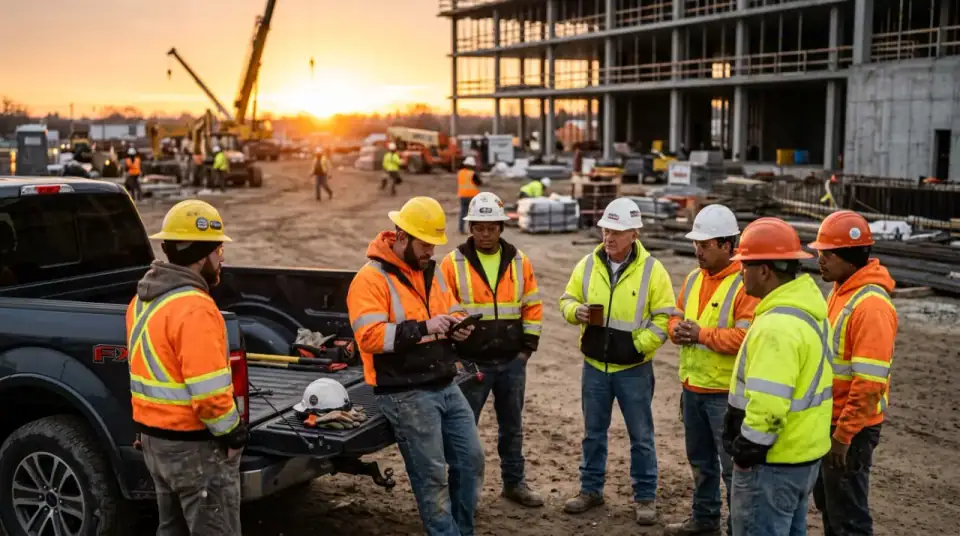
AI-generated stand-in photo, not a customer site.
Questions
Something else? Ask a person.
What are good safety topics for January?
OSHA's Focus Four for the first week back, then cold stress, cold starts and heavy equipment, and heaters with fire extinguishers. Backups: carbon monoxide, ice and slips, three points of contact, and trench walls that thaw.
Does OSHA have a cold weather standard?
No. OSHA has no standard for work in the cold, but employers must still protect workers from recognized hazards under the General Duty Clause, and heaters need fresh air (29 CFR 1926.154). OSHA's winter weather page has the signs and the first aid.
When is the OSHA 300A due?
Post last year's 300A summary by February 1 and keep it up until April 30 (29 CFR 1904.32(b)(6)). If your establishment has to submit it online, the deadline is March 2 (29 CFR 1904.41(c)).
What should the first safety meeting of the year cover?
The big picture, then today's work. Go through the Focus Four with an example of each on your site, remind everyone that anyone can stop unsafe work, and walk the site before anyone starts, since it sat over the break.
What are the signs of hypothermia and frostbite?
Hypothermia starts with shivering, tiredness, clumsiness and confusion; later the shivering stops and the person can pass out. Frostbite shows as numbness, tingling or stinging, and pale, waxy or bluish skin (NIOSH). Get them warm and get help.

Put an AI foreman on your site.
Tell it about your site. It sets up the rest.