Safety moments: 40 one-minute topics for construction.
Say a few lines, ask one question, and get to work.
- Mon: The counterweight
- Tue: If you can't see the mirrors
- Wed: Ticket before the shovel
- Thu: Six feet
- Fri: The drive home
Today, the counterweight: An excavator's back end swings out past its tracks, and the operator can't see it. If you can reach out and touch the machine, you're inside the swing.
Ask the crew: Where's the swing line on the excavator today?
From the talk: Swing radius and spotters
- 1Sign upWith email, Google or Apple.
- 2Tell it about the siteLike you'd tell a new foreman.
- 3It opens, built for your siteJHA & talks, plus crew sign-off on one phone
A safety moment is a one-minute safety talk at the start of a shift or a meeting: one hazard, a few plain lines and one question for the crew. Here are 40 for construction and earthwork sites, grouped by hazard. Each one has the question to ask and a link to the full five-minute toolbox talk it comes from.
How to run a safety moment in 60 seconds
- Pick the one that matches today's work. Trucks backing in all day? Use a backing moment, not ladders.
- Stand where the crew can see the hazard: the trench, the truck, the cord. Say the lines in your own words.
- Ask the question and wait. The quiet ones often know where the problem is.
- Fix what comes up before work starts. If it turns into a real discussion, give the full talk and get signatures.
40 safety moments for construction
Every moment comes from one of Dozer's free toolbox talks, so the facts and the OSHA rule behind it are on the talk's page.
Machines and the swing radius
- The counterweight. An excavator's back end swings out past its tracks, and the operator can't see it. If you can reach out and touch the machine, you're inside the swing. Ask: Where's the swing line on the excavator today?
Full talk: Swing radius and spotters - Eye contact first. Before you walk toward a machine, get the operator to look at you and nod. Your wave isn't enough; you need theirs back. No eye contact, no closer. Ask: What do you do when the operator doesn't see you?
Full talk: Heavy equipment safety - Parked means down. A parked machine has its bucket, blade or bed on the ground, the brake set and the engine off. Something left up can come down with nobody in the seat. Ask: Which machine got parked with something up last week?
Full talk: Heavy equipment safety - Seat belt, every move. In a rollover, the belt keeps you inside the cage. People who jump get caught under the machine. Belt on, even to move it across the yard. Ask: Who skips the belt for a quick move?
Full talk: Seat belts and rollovers - Getting on and off. A slip off the steps can break an ankle or a back. Face the machine and keep two hands and a foot on it. Never jump off a track. Ask: Whose steps are the muddiest or iciest today?
Full talk: Three points of contact
Trucks, backing and the road
- If you can't see the mirrors. If you can't see the driver's mirrors, the driver can't see you. A dump truck's blind spots can hide a whole person. Walk where the driver can see you. Ask: Where does the truck back up today, and who spots it?
Full talk: Backing up and blind spots - A dead backup alarm. A backup alarm that doesn't sound gets reported before the truck moves again. Don't trust a working one either. People stop hearing them after a while. Ask: Who checks the alarms in the morning?
Full talk: Backing up and blind spots - Your back to traffic. The traffic side is the dangerous side. Keep your back off it and always know your way out. Cones mark the zone; they don't stop a car. Ask: Where do you go if a car comes through the cones?
Full talk: Flagging basics - Phone down near machines. No phone while you're operating or spotting. Step out of the swing and off the haul road to take a call. One text is long enough to miss a backing truck. Ask: Where's a safe spot to take a call on this site?
Full talk: Phones and distraction - The drive home. After a long shift you're not as sharp as you feel. Take the break before the drive, not after. If you're nodding off, pull over and rest. Ask: Who's driving more than an hour home tonight?
Full talk: Working at night
Trenches and digging
- Ticket before the shovel. Every dig needs an 811 ticket, even a post hole. Check the ticket is still good and every utility has marked or cleared. No marks, no dig. Ask: When does today's ticket run out?
Full talk: Call 811 before you dig - Five feet. At 5 feet deep a trench needs a box, shoring or a slope. Cave-ins rarely warn you. Nobody gets in to check something quick. Ask: How deep is the deepest cut today, and what's protecting it?
Full talk: Trench boxes - Spoils two feet back. Spoil piles and equipment stay at least 2 feet from the edge. Weight on the edge pushes the wall in, and rocks roll. Ask: Is anything closer than 2 feet right now?
Full talk: Trench ladders and spoil piles - Your way out. In a trench 4 feet or deeper, a ladder, ramp or stairs is within 25 feet of you. If the wall moves, you need out now. Ask: How many steps is it from where you'll work to the ladder?
Full talk: Trench ladders and spoil piles - Cracks and bulges. Cracks along the top, a bulging wall, water seeping in or dirt trickling down: get out first, then call the competent person. Rain overnight means a fresh look. Ask: Who's the competent person on this dig today?
Full talk: Cave-in warning signs
Falls and ladders
- Six feet. Six feet up, you need a guardrail, a cover or a harness. Open edges and holes count. Most falls happen on quick jobs nobody planned. Ask: Where's an open edge or hole on this site today?
Full talk: Guardrails and hole covers - Three feet over. An extension ladder sticks up 3 feet past the landing, sits 1 foot out for every 4 up, and gets tied off. Firm footing, never on a bucket. Ask: Which ladder here isn't tied off?
Full talk: Ladder setup: 4 to 1, 3 feet over - The top step. The top of a stepladder isn't a step. If you need it, get a taller ladder. Never lean a folded stepladder on a wall and climb it. Ask: Do we have the right ladders for today's heights?
Full talk: Stepladders - Look at your harness. Check the webbing, stitching, buckles and D-ring before you put it on. A deployed shock pack means out of service. A harness that caught a fall is done. Ask: When did you last really look at yours?
Full talk: Check your harness - Who gets them down? Hanging in a harness cuts off blood flow, so rescue has to be fast. Before anyone ties off, know how you'd get them down. Ask: If someone fell right now, what's the plan?
Full talk: Fall rescue
Hands and pinch points
- Hands out of the gap. Tailgates, bed hinges, hitch pins and trench box panels close with tons of force. If your hand fits in the gap, so does the crush. Line it up with a bar. Ask: What's the worst pinch point on today's work?
Full talk: Pinch points - Blocked, not held. Never work under a bed, bucket or blade held up only by hydraulics. Lower it or block it first. Hoses let go without warning. Ask: Where are the blocks and the bed prop on this site?
Full talk: Caught-in and caught-between - Your lock, your key. Before you reach into a machine, shut it down, lock it and tag it. Try to start it to be sure. Nobody takes your lock off but you. Ask: Who has a lock and tag on them today?
Full talk: Lock it out - Guards stay on. A guard is there for the day the wheel breaks or the blade binds. A pinned-back guard is how fingers come off. Unplug before you change a blade. Ask: Is every guard on every tool in the gang box?
Full talk: Power tool guards - Out from under. Nobody under a load, ever. Guide it with a tag line, not your hands. Rigging fails without warning. Ask: Where does the load travel on today's lifts?
Full talk: Never under the load
Heat, cold and storms
- Drink before you're thirsty. On hot days, drink about a cup of water every 15 to 20 minutes, thirsty or not. New people are most at risk in their first week. Ask: Where are the water and the shade today?
Full talk: Heat illness - Heat stroke is a 911 call. Confused, slurring, stopped sweating or passed out: that's heat stroke. Call 911 and cool them with water and ice right away. Don't wait to see. Ask: What's this site's address for 911?
Full talk: Heat illness - Layers and dry socks. Cold and wet pull heat out of you fast. Wear layers you can take off before you sweat. Keep dry socks and gloves in the truck. Ask: Who has dry spares with them today?
Full talk: Cold stress - Heaters need air. Propane and kerosene heaters make carbon monoxide, and you can't smell it. A headache or dizziness in an enclosure means get out to fresh air. Ask: Is there a CO monitor where the heater runs?
Full talk: Carbon monoxide - When thunder roars. Hear thunder, get in a building or a hard-top vehicle. Booms come down and people get out of wet trenches. Wait 30 minutes after the last thunder. Ask: Where's our shelter, and who calls the all-clear?
Full talk: Lightning: 30 minutes
Dust, noise, air and chemicals
- Wet the blade. Cutting concrete or block dry throws silica dust that scars your lungs for good. Water on the blade or a vacuum shroud, every cut. Ask: Is the water hooked up on the saw?
Full talk: Silica dust - No dry sweeping. Dry sweeping and blowing off with air put the dust right back in your face. Wet it down or use a HEPA vac. Ask: What are we cleaning up with today?
Full talk: Silica dust - If you have to shout. If you have to shout to be heard at arm's length, it's too loud. Plugs in, rolled thin so they expand in the ear. Hearing loss doesn't come back. Ask: Which job today is loud enough for plugs?
Full talk: Hearing protection - Bad air in the hole. A manhole, vault or tank can hold air that kills, and you can't smell it. Test before you go in and while you're in. Never go in after someone who went down. Ask: Who has the gas monitor, and when was it bump-tested?
Full talk: Confined spaces: test before you enter - Read the label. Every chemical on site has a label and a safety data sheet. Know the gloves and first aid before you open the can. Never pour it into an unmarked bottle. Ask: Where's the SDS binder for this site?
Full talk: Read the label and SDS
Lines, power and fire
- Look up. Before you raise a bed, boom or mast, look up. Keep 10 feet from lines up to 50 kV. Don't know the voltage? Keep 20 feet and call the utility. Ask: Where are the overhead lines on this site?
Full talk: Overhead lines - If the machine touches a line. Stay in the cab and wave everyone back. The ground around the machine can be live. Nobody touches the machine until the utility says it's dead. Ask: Who calls the utility, and what's the number?
Full talk: Overhead lines - Test the GFCI. Push the test button before you plug in. A cord with cuts, a missing ground pin or a taped splice goes out of service. Keep cords out of water. Ask: When did someone last push the test button on the spider box?
Full talk: GFCIs and cords - If you hit gas. Smell gas or hear it hiss: stop, shut engines off if it's safe, and get everyone upwind. No phones or switches near it. Call 911, then the gas company. Ask: Which way is upwind right now?
Full talk: If you hit a gas line - Engine off to fuel. Shut the engine off before you fuel, and no smoking. Fill cans on the ground, not in the truck bed. Clean up a spill before it reaches a drain. Ask: Where's the spill kit?
Full talk: Fueling equipment
Safety topic of the day: a four-week plan
No time to pick? Use this plan: one moment a day, Monday to Friday, four weeks, then start over. Each week covers machines, trucks, digging, falls and power. On a hot or icy week, swap Thursday for a heat, cold or storm moment. For the season and the dates on the calendar, use the monthly safety topics.
Safety observation examples
A safety observation is what someone saw on site, good or bad, written down so it gets fixed or repeated. Say it plainly: who, where, what happened and what was done. These ten are the kind a crew turns in.
| Kind | What they saw |
|---|---|
| Good catch | The operator stopped swinging when a laborer walked behind the excavator, and waited for eye contact. |
| Good catch | A driver found the backup alarm dead on the morning walk-around and parked the truck until it was fixed. |
| Near miss | A pipe section rolled off the stack toward the trench while two people stood below. No one was hit. The stack wasn't chocked. |
| Near miss | A tailgate dropped while a laborer was knocking mud off the hinge. Their hand was out of the gap by inches. |
| Near miss | A raised dump bed came within about 10 feet of the overhead line on the north side. The spotter called stop. |
| At-risk | A worker stood between the haul truck and the stockpile while the truck backed in. |
| At-risk | The spoil pile on the east side of trench run C was right at the edge, inside 2 feet. |
| At-risk | The extension ladder at the pump pad was not tied off and stuck up about a foot past the landing. |
| Safe behavior | The saw crew had water on the blade for every cut, and wet-swept after. |
| Safe behavior | A new hire asked where the ladder was before getting in the trench, and the foreman walked them to it. |
A near miss is a free lesson: nobody got hurt this time. Write it up on a near-miss and incident report and read it out as tomorrow's safety moment. Good catches deserve a thank-you in front of the crew. If someone was hurt, check whether it goes on the OSHA 300 log.
Safety moment or toolbox talk?
A safety moment is one point in a minute, good for the start of any meeting. A toolbox talk is about five minutes on one topic with a few questions and a sign-in sheet, and it's the better record that training happened. Use moments to keep safety in the room every day, and a full talk at least once a week. Start the day's talk from the job hazard analysis: each JHA names the talk that goes with the task.
Want more structure? The monthly calendar gives four talks a month for the season, and a safety stand-down stops the job for a longer session. For the big four killers in construction, use the Focus Four toolbox talk, and teach stop work authority so anyone can call a stop.
Dozer drafts the day's talk from what you say the crew is doing. The crew signs on one phone and it's logged with the day.
Send a talk to my crewA starting point, not legal or safety advice. Match each moment to your site, your crew and your company's safety plan.
Tomorrow, the crew signs it on one phone.
Dozer writes the JHA and the toolbox talk from what you say about the work.
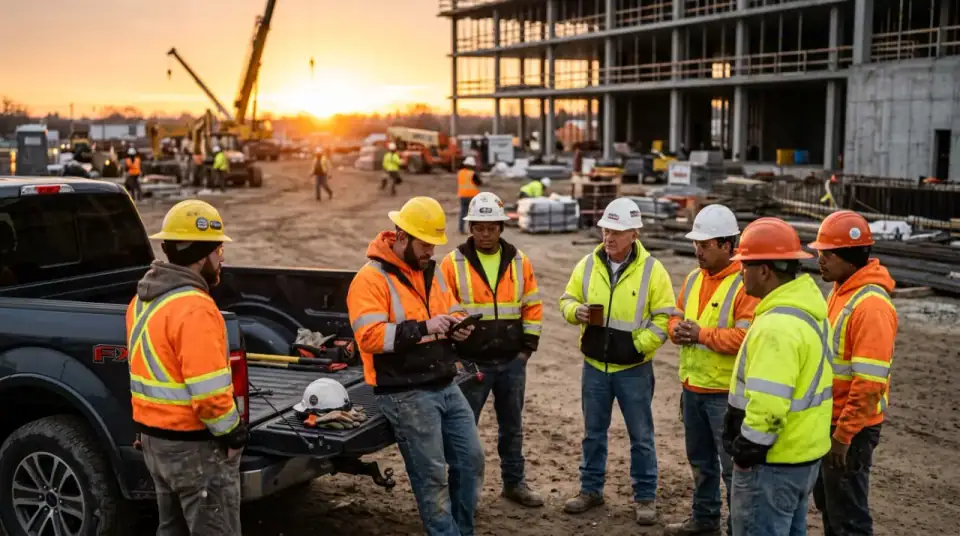 LIVE Toolbox talk · trench safety · 12 signed
AI-generated stand-in photo, not a customer site.
Questions
Something else? Ask a person.
What is a safety moment?
A one-minute safety talk at the start of a meeting or a shift. One hazard, a few plain lines, and one question for the people in the room. It's shorter than a toolbox talk and usually isn't signed.
What is a good safety topic for today?
The one that matches today's work and weather. Digging today: the 811 ticket or the 5-foot rule. Trucks backing in: mirrors and blind spots. Hot or icy: heat or cold. If nothing stands out, use the four-week plan on this page, and the monthly calendar for the season.
How long should a safety moment be?
About a minute. Say three or four lines, ask one question and wait for an answer. If the crew has more to say, that's a toolbox talk, so give the full five-minute talk and get signatures.
What is the difference between a safety moment and a toolbox talk?
A safety moment is one point in about a minute, often at the start of any meeting. A toolbox talk is about five minutes on one topic, at the start of a shift, with questions and a signed sign-in sheet that shows the training happened.
What are examples of safety observations?
A good catch (the operator waited for eye contact), a near miss (a tailgate dropped with a hand nearby), an at-risk act (someone stood between a backing truck and a stockpile) or a safe behavior (water on the saw blade for every cut). Write down what was seen, where, and what was done about it.
Do safety moments count as OSHA training?
They help, but they don't replace it. OSHA requires each worker to be taught to recognize and avoid the hazards of their work (29 CFR 1926.21(b)(2)), and some topics, like fall protection, have their own training rules. A signed toolbox talk is a better record than a moment.
Put an AI foreman on your site.
Tell it about your site. It sets up the rest.